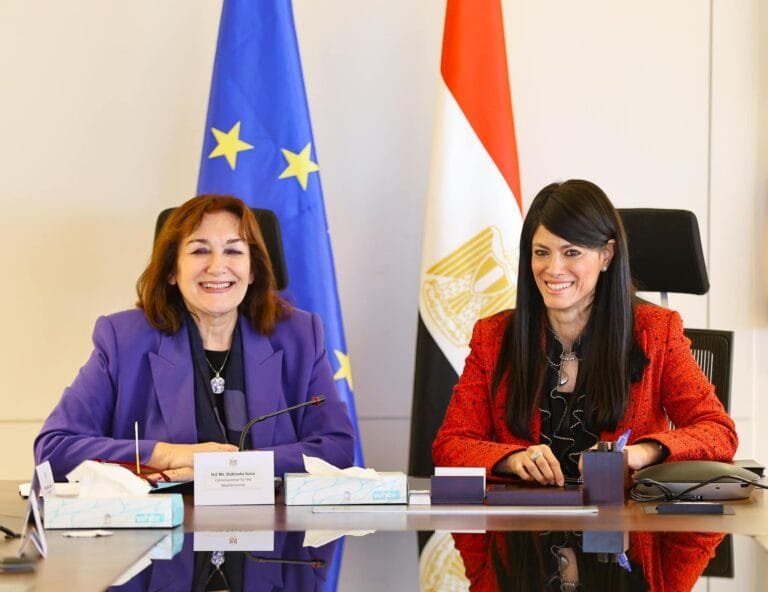
Cairo, Egypt – Dr. Rania Al-Mashat, Egypt’s Minister of Planning, Economic Development, and International Cooperation, witnessed the signing of a €90 million grant agreement from the European Union, managed by the European Investment Bank, to bolster investments in Egypt’s electricity grid and develop renewable energy capacity. A €35 million grant was also signed with the Norwegian company Scatec for a green hydrogen project in Ain Sokhna. These signings took place during a conference organized by the European Union entitled “Sustainable Energy in Egypt 2040: Cooperation for Shared Prosperity.” The event was attended by Mahmoud Esmat, Minister of Electricity and Renewable Energy; Angelina Eichhorst, EU Ambassador to Egypt; and Walid Gamal El-Din, Chairman of the General Authority for the Suez Canal Economic Zone. Also present were the ambassadors of Spain and France and representatives of European banks.
The Minister affirmed that the transition to sustainable, secure, and efficient energy systems is a key driver of comprehensive development in Egypt. She noted that the country has adopted an ambitious vision for the energy sector up to 2040, based on expanding renewable energy sources, enhancing energy efficiency, and maximizing the utilization of diverse resources. This, in turn, strengthens Egypt’s position as a regional energy hub in the Eastern Mediterranean. She pointed out that the launch of the comprehensive strategic partnership between Egypt and the European Union in March 2024 marked a turning point in bilateral relations. In this context, cooperation focuses on supporting the energy transition through integrated packages of concessional financing, investment guarantees, and technical assistance.
The Minister also reviewed the experience of the NOVI platform, which, over three years, successfully mobilized approximately $5 billion to implement renewable energy projects with a capacity of 4.2 gigawatts through the private sector. She emphasized the role of the European Fund for Sustainable Development Plus (EFSD+) in stimulating European investments in renewable energy, green hydrogen, energy efficiency, and electricity grid modernization. Dr. Al-Mashat explained that the energy transition is a key component of the national narrative for comprehensive development. She further emphasized that this narrative focuses on linking economic policies with investment in human capital, strengthening the role of the private sector, and promoting the green transition. This ensures inclusive and sustainable growth and enhances the resilience of the Egyptian economy to global shocks. She affirmed that Egypt’s commitment to energy transition is a long-term commitment based on partnership, innovation, and sustainable investment to achieve economic development and clean energy.