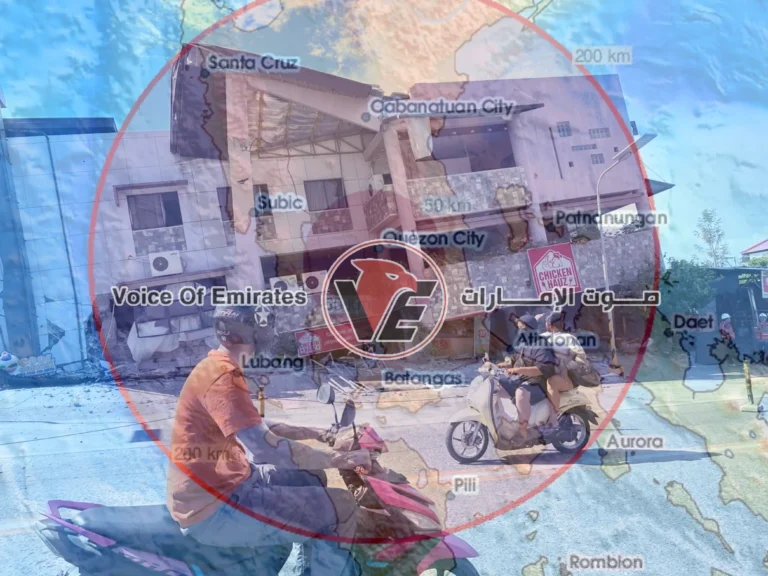
Manila, Philippines – The Philippine Department of Environment announced that the powerful earthquake that struck the country this week, killing at least 61 people, caused the seabed to rise by approximately two meters.
This resulted in the exposure of large areas of coral reefs. Significant damage was
also inflicted on the marine ecosystem in various parts of the southern Philippines.
Unprecedented coastal rise
The 7.8-magnitude earthquake that struck Mindanao Island has left
at least 40 people missing, according to a new tally from the disaster agency.
Search and rescue operations are continuing in the affected areas.
The Department of Environment reported that residents of coastal areas observed
a geological phenomenon known as “coastal uplift” two days after the earthquake.
The coastline extended by up to 200 meters in some locations, resulting in a noticeable change in the shape of the coastline.
Cotabato Trench movement
The Philippine Institute of Volcanology and Seismology (PHIVOLCS) explained
that the earthquake was caused by movement in the Cotabato Trench.
This movement uplifted parts of the coastlines in Sarangani and Davao Occidental provinces,
exposing areas that were previously submerged. Landslides of up to two meters were recorded in some areas.
PHIVOLCS noted that the region experiences frequent seismic activity.
Thousands of minor tremors have been recorded in the Cotabato Trench in recent months.
This reflects the active geological nature of the southern Philippines and the high probability of continued aftershocks in the coming period.