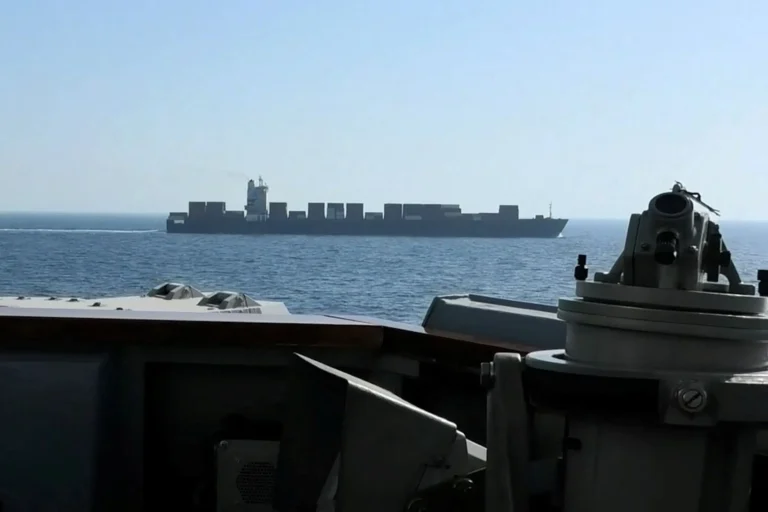
Washington, United States – Amid the ongoing escalation to enforce a “naval blockade” on Iranian ports, the United States announced on Saturday that it successfully disabled another commercial vessel attempting to breach the blockade. The vessel was trying to reach its Iranian destination. Associated Press quoted an informed U.S. official stating that the U.S. military halted the bulk carrier “Liyan Star,” flying the Gambian flag. Its crew ignored repeated warnings from American forces overnight. The official explained that U.S. aircraft intervened to disable the vessel in the Gulf of Oman. Notably, it remains adrift at its location without American forces boarding it.
A Continuous Chain of Maritime Interceptions
This operation unfolds at a time of mounting maritime friction in the region. This incident marks the seventh of its kind where the U.S. military has intercepted vessels attempting to run the blockade. The blockade was officially imposed on April 17th. It came in response to Iran’s de facto closure of the Strait of Hormuz after joint U.S.-Israeli strikes on February 28th. The American blockade aims to slash Iran’s private shipments. As a result, it seeks to dry up foreign currency reserves and weaken the Iranian economy, which has long faced stifling pressures.
Anticipation Over Truce Extension and Diplomatic Outcomes
On the diplomatic front, the region is in a state of high alert. A “fragile ceasefire” established on April 7th continues to hold. The international community is closely awaiting a decision regarding a 60-day extension of the truce. This outcome is intricately tied to the future of talks surrounding the Iranian nuclear program. U.S. President Donald Trump convened a meeting with his advisers on Friday to deliberate options for extending the truce and reopening the Strait. However, informed sources confirmed that a final decision has not yet been reached. This is happening amid Iranian signals indicating the agreement remains unfinalized.
Washington persists in sending firm operational messages through these interceptions, asserting its resolve to maintain control over strategic maritime corridors. Meanwhile, global diplomacy continues to seek a breakthrough to prevent the region from sliding into an all-out confrontation. All factions emphasize that the keys to a resolution remain tied to the balance of power on the ground and within the Strait of Hormuz.