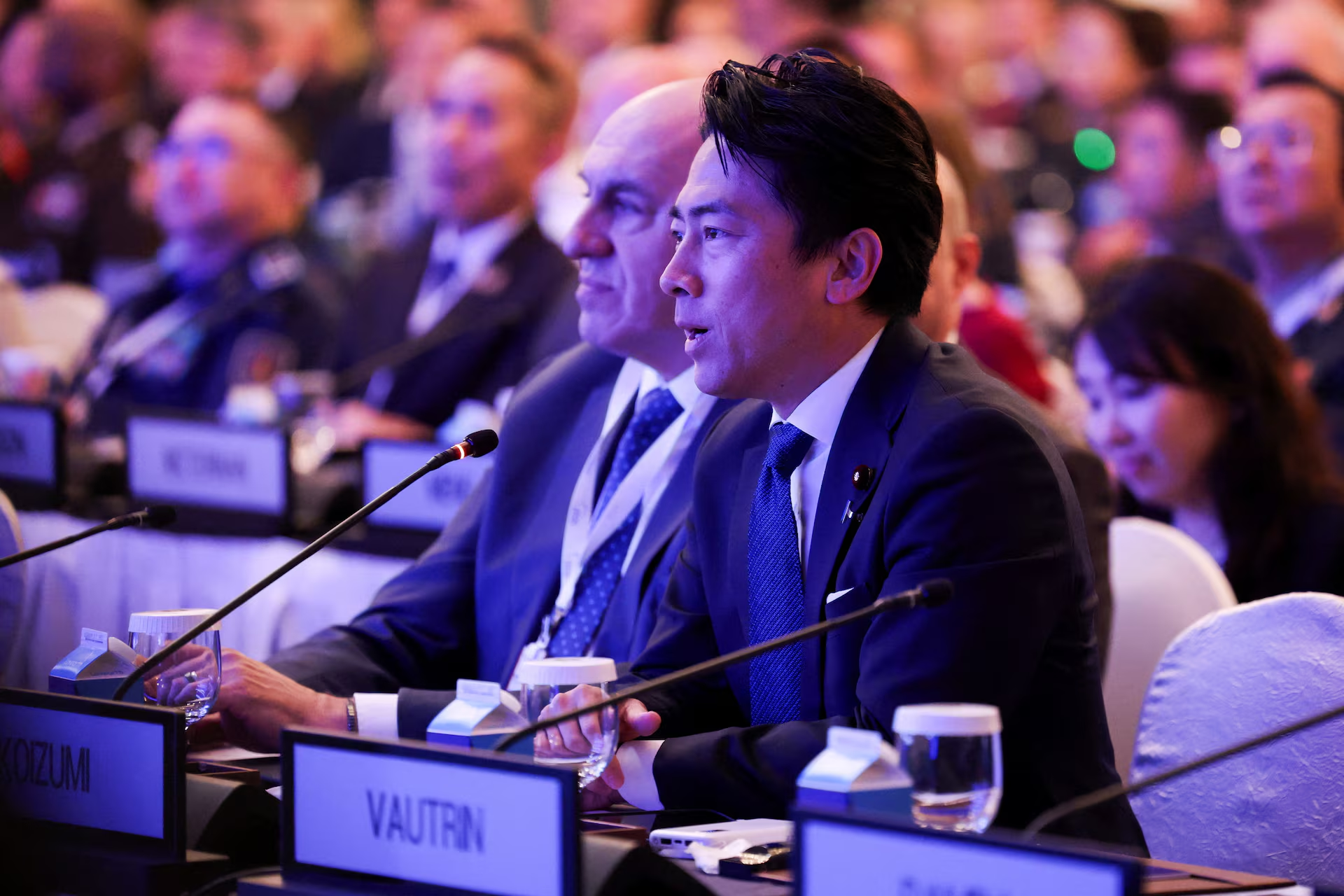
Singapore – In an international move aimed at protecting the “arteries of the global economy” from growing threats, 17 countries around the world have agreed to launch “Guidelines for Mutual Defense of Undersea Infrastructure.”
This announcement came on the sidelines of the Shangri-La Dialogue Asian security conference in Singapore, following a series of mysterious incidents involving undersea cables in the Baltic Sea and the Taiwan Strait. These incidents have raised concerns that the seabed could become a new battleground.
Alliance of 17: Protecting the new “battlefield”
The alliance includes countries from the Asia-Pacific region (Australia, Singapore, the Philippines, Thailand, Malaysia, Brunei, and New Zealand), European countries (France, the United Kingdom, Italy, the Netherlands, Sweden, Finland, and the three Baltic states), and Qatar. These voluntary, non-binding guidelines are based on adherence to the United Nations Convention on the Law of the Sea (UNCLOS). They focus on intelligence sharing and strengthening joint responses to crises that could threaten undersea communications and power lines.
In this context, Australian Deputy Prime Minister and Minister of Defence Richard Marles described the seabed as a “battlefield,” noting that repeated incidents—whether accidental or deliberate—have exposed the fragility of global infrastructure. Marles stated, “Our ability to function as a modern economy depends critically on this exposed infrastructure.”
Concerns about the fragility of global connectivity
For his part, Singapore’s Defense Minister Chan Chun Seng emphasized that waterways are no longer merely trade routes, but have become home to vital energy and communications networks. He stressed the urgent need for rigorous international standards on how these networks are installed and managed to prevent their sabotage. He expressed his hope that this initiative would serve as the foundation for broader international discussions.
The absence of superpowers and the paradox of challenges
Despite the importance of this step, observers noted the absence of the two superpowers, the United States and China, from this alliance.
This initiative comes against a backdrop of heightened tensions. Since the outbreak of war in Ukraine in 2012, infrastructure in the Baltic Sea has been subjected to a series of incidents. These began with the Nord Stream pipeline explosion—in which investigations revealed the involvement of Ukrainian intelligence—and the Gulf of Finland cable incident involving a Russian cargo ship.
In the Far East, concerns have grown regarding Taiwan’s undersea cables, which have repeatedly suffered suspicious damage attributed to Chinese vessels. While countries continue to bolster their underwater digital and physical security, the greatest challenge remains how to forge a “global system” to protect these cross-border assets. This is especially true in an international environment characterized by intense competition and mistrust among major powers.