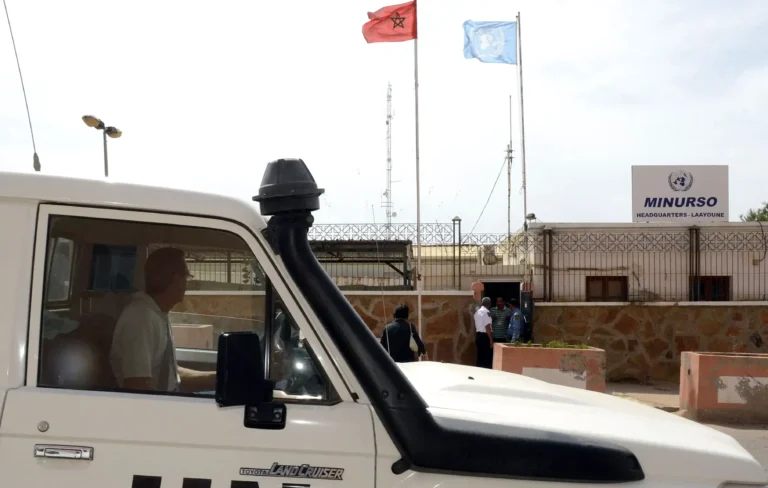
Laayoune, Morocco – In a move reflecting the seriousness of the international commitment to reforming the peacekeeping system, a high-level delegation comprising senior officials
and experts from the United Nations Department of Peacekeeping Operations arrived in the Moroccan city of Laayoune.
The field visit is part of a comprehensive evaluation of the performance of the MINURSO mission.
This comes more than three decades after its establishment in 1991,
and amidst rapidly evolving political and security developments in the region.
Field visits and comprehensive assessment
The delegation, headed by Lieutenant General Cheryl Pierce, Acting Military Advisor to the United Nations,
began an intensive tour of the mission’s headquarters and barracks.
Through this firsthand observation, the delegation aims to assess the working conditions of personnel
and evaluate the effectiveness of the tasks being carried out on the ground.
The visit began with an official military reception at the mission headquarters in Laayoune.
This was followed by bilateral meetings with the Special Representative of the Secretary-General,
Alexander Ivanko, and the Force Commander of MINURSO, Major General Mohamed Fakhroul Ahcene.
Additionally, videoconferences were conducted with all field sites.
Visits were also made to the Smara and Bir Lahlou team sites to examine the logistical and operational challenges.
Reconsidering the UN mandate
This visit is part of the preparation of a strategic assessment report to be submitted to decision-making bodies in New York.
This report is expected to form the cornerstone for a review of the mission’s mandate,
both in terms of the nature of its tasks and its operational mechanisms.
This move comes within the context of international pressure, led by the United States,
to link the continuation of long-term missions to achieving tangible political results and reducing financial costs.
Mike Waltz, the US representative to the United Nations, confirmed before Congress that Washington is conducting
a “strategic review” of the mission to ensure its effectiveness as a tool
to support the political process and not merely to perpetuate the status quo.
These developments confirm that the next phase of MINURSO will depend heavily on the outcomes of this assessment.
The report aims to shift from “peacekeeping” to “promoting a lasting solution.”
This aligns with the international dynamic that prioritizes political efficiency over traditional administrative considerations.