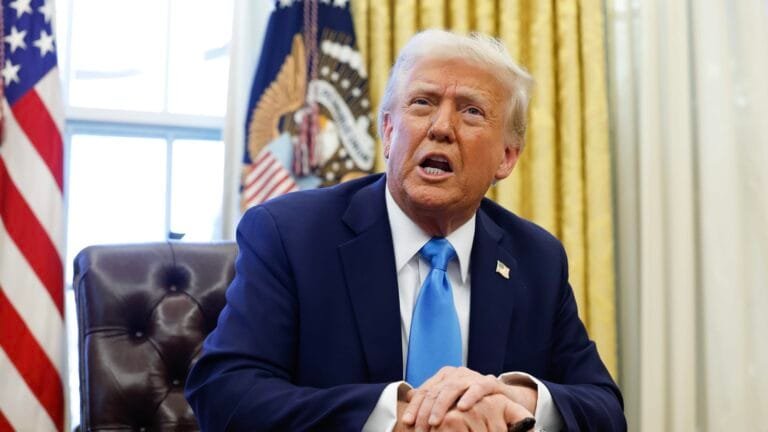
Washington, DC – In a controversial tweet reflecting his hardline strategy toward Tehran, US President Donald Trump declared that the United States would accept nothing less than the Iranian regime’s “unconditional surrender” to end the current conflict. He simultaneously promised to transform Iran into a major economic power under new leadership.
No negotiations… only “surrender”
Through his platform, Truth Social, Trump settled the debate about the possibility of reaching a middle-ground political settlement at present. He stated unequivocally: “There will be no deal with Iran except unconditional surrender.” These remarks come at the height of military operations aimed at undermining the strategic capabilities of the Revolutionary Guard. This indicates that Washington has decided to move forward with a fundamental shift in the balance of power.
Vision of “Great Iran Once Again”
Despite his hawkish, militaristic tone, Trump extended an olive branch to the Iranian people, contingent on a change in leadership. He explained that after the selection of a “great and acceptable leader (or leaders),” the United States would begin working with its “courageous” allies and partners on a large-scale reconstruction effort.
Trump pledged to work tirelessly to “bring Iran back from the brink of destruction.” He also affirmed his commitment to making it “bigger, better, and stronger economically than ever before.” Trump used his famous slogan in a new version specifically for Tehran, saying, “Make Iran Great Again (MIGA).” This indicates his desire to replicate the economic growth model he has consistently promoted.
The future after the confrontation
Trump asserted that Iran possesses the potential for a “great future.” However, he linked this prosperity to the end of the current regime’s era. He also connected it to the beginning of a new era of cooperation with the international community. Observers believe that Trump’s statements aim to undermine the internal cohesion of the Iranian regime by appealing to public opinion. In addition, he offers an attractive economic alternative in exchange for ending the conflict.
These remarks come at a time of increasing military and economic pressure on Tehran. Thus, these statements outline a US policy that goes beyond mere containment and seeks to impose a completely new geopolitical reality in the Middle East. In this reality, Iran becomes an economic partner rather than a “strategic adversary.”