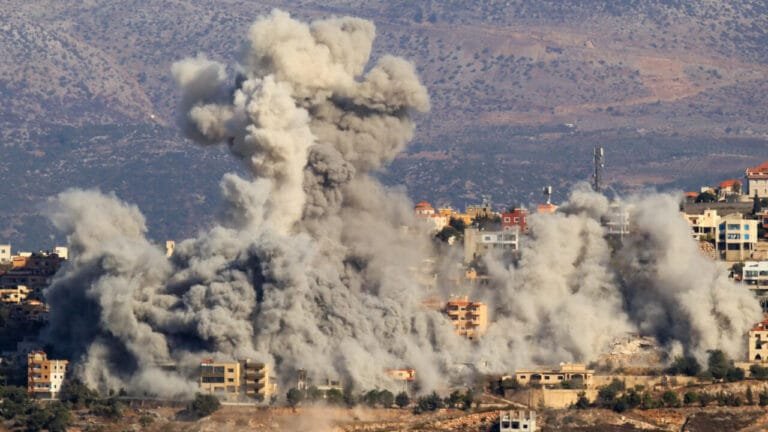
Beirut, Lebanon – Israeli forces launched a series of airstrikes on Friday, the most intense of their kind, targeting Beirut’s southern suburbs and various areas in the Bekaa Valley and southern Lebanon. As a result, the number of airstrikes on the southern suburbs alone since the start of the conflict with Iran has risen to 26.
This escalation coincided with the Lebanese Ministry of Health’s announcement of a tragic increase in the number of casualties. This comes amidst an unprecedented wave of displacement.
Victims in the Bekaa and the South
The Lebanese Health Emergency Operations Center reported that the death toll from Israeli attacks from dawn on Monday until Thursday evening reached 123, with 683 wounded. The Bekaa Valley witnessed particularly deadly strikes; an airstrike on a house in the town of Mashghara killed four civilians, including a five-year-old girl and a seven-year-old boy. Two people were also killed and others wounded in the town of Labaya. Meanwhile, airstrikes targeted the towns of Douris, Brital, and Taybeh after Israeli warnings to residents to evacuate. In the south, towns in the Nabatieh, Tyre, and Marjeyoun districts were subjected to a series of extensive airstrikes that caused widespread destruction to residential areas. These attacks resulted in casualties in the towns of Ma’raka, Srifa, Shahabiya, and Qalila.
Southern suburbs: “A night of intense airstrikes”
Israeli warplanes began their raids on the southern suburbs of Beirut at approximately 10:45 PM, targeting the neighborhoods of Haret Hreik, Jammous, Mushrifieh, and Kfarhat. The strikes also hit the vicinity of Al-Sahel Hospital and the Hadi Nasrallah highway. This followed unprecedented Israeli warnings to evacuate entire neighborhoods, leading to widespread panic and a mass exodus of residents. At the time, residents were still living in the area. For his part, the Israeli military spokesperson stated that the attacks targeted command centers and 10 high-rise buildings. He claimed these buildings housed Hezbollah’s military infrastructure, including the headquarters of the Executive Council and drone storage facilities.
Official mobilization and field movements
On the ground, the Israeli army advanced into border towns such as Kfarshouba and Qouzah, taking up positions previously held by the Lebanese army after the latter withdrew. Politically, Lebanese President Joseph Aoun affirmed that the decision to restrict “war and peace” to the state and to prohibit all illegal military activities is a “final sovereign decision.” Regarding relief efforts, Minister of Social Affairs Hanin al-Sayed announced the commencement of cash assistance payments to 50,000 displaced families. She also confirmed that public schools and universities have been opened as shelters. She urged families to head to the North, Akkar, and the Bekaa Valley, given their greater capacity to accommodate them.