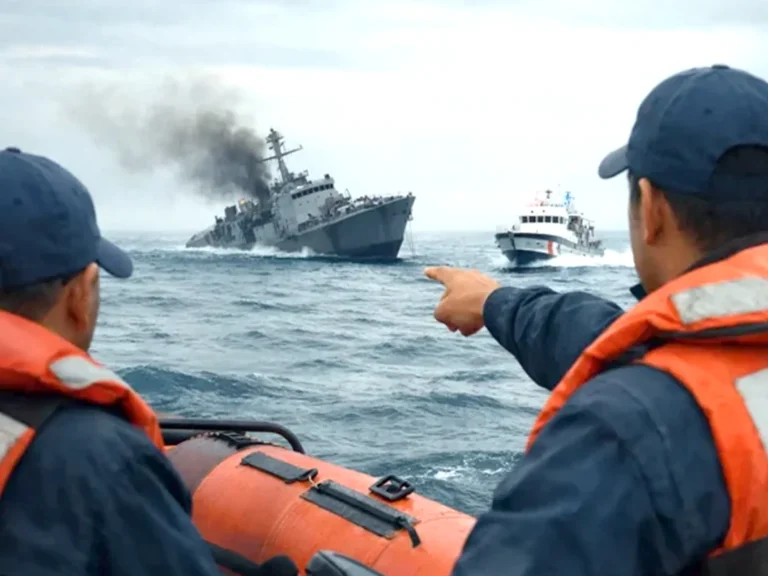
Colombo, Washington – In a dangerous escalation reflecting the broader scope of the current maritime confrontation, the Sri Lankan Ministry of Foreign Affairs announced on Wednesday the sinking of the Iranian frigate IRIS Dena off the country’s coast. This incident coincided with the United States’ announcement of a complete maritime embargo on Iranian shipping in the region.
Rescue operation in the Indian Ocean
Sri Lankan Foreign Minister Vijeetha Herath confirmed that his country’s navy and air force responded to a distress call from an Iranian frigate at dawn. The vessel, carrying a crew of 180, was sinking approximately 40 nautical miles outside the island’s territorial waters. Herath stated that 30 sailors have been rescued so far. Additionally, those injured have been transported to hospitals in the south of the country. However, the cause of the sinking remains officially undisclosed. This is happening amidst parliamentary inquiries into whether the ship may have been struck by shelling during ongoing military operations.
Washington: “Complete blockade” and the disappearance of Iranian shipping
For his part, the commander of U.S. Central Command (CENTCOM), Admiral Brad Cooper, painted a grim picture of the Iranian navy’s situation. In a televised briefing Wednesday, Cooper announced a strict maritime blockade that has completely paralyzed Iranian shipping.
“Not a single Iranian vessel is currently sailing in the Persian Gulf, the Strait of Hormuz, or the Gulf of Oman,” Cooper stated firmly. “Our forces are putting pressure on the Iranian regime from the sea and have it cornered within its ports.”
Total losses: 17 ships and 2,000 targets destroyed
The US military official revealed the extent of the damage inflicted on Iranian military capabilities during Operation Epic Fury.
He confirmed the destruction of 17 Iranian ships and one submarine, described as “the most advanced,”
in addition to targeting nearly 2,000 targets deep inside Iran using B-2 and B-1 strategic bombers.
Cooper emphasized that the military operations are significantly ahead of schedule.
He explained that joint air and naval control with Israel is now a reality. This new reality prevents Tehran from threatening international shipping as it has done for decades.
The future of escalation
These developments leave the Iranian regime with limited options, as it faces a naval blockade stretching from the Gulf to the fringes of the Indian Ocean.
Simultaneously, it is losing key pieces of its naval fleet. This situation reinforces speculation about the imminent collapse of the logistical capabilities of the Islamic Revolutionary Guard Corps Navy.