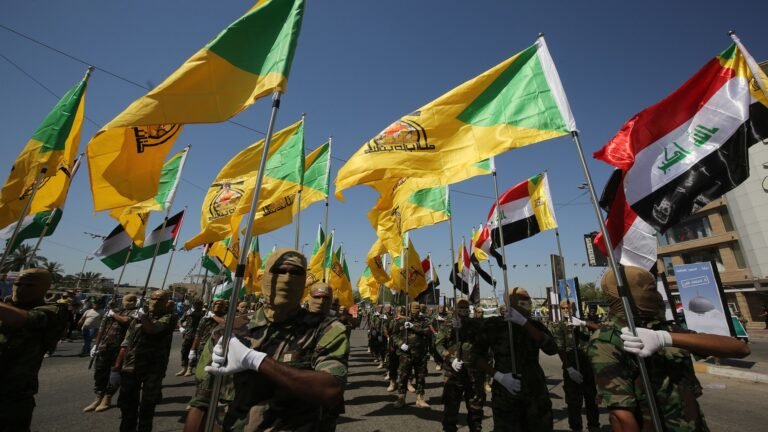
Baghdad, Iraq – The Iraqi Hezbollah Brigades announced on Thursday that they have raised their fighters’ readiness to the highest level, calling on them to prepare for a “protracted war of attrition.”
This comes in the event that the United States launches a military attack against the Islamic Republic of Iran.
Warnings of a dangerous escalation
In an official statement, the group, considered one of the most prominent factions of the “Axis of Resistance” in Iraq, indicated
that the recent US military movements in the region represent a “dangerous escalation of tensions.” The statement read:
“In light of the continued US threats and the increasing military presence in the region,
it has become imperative for all fighters to prepare for a potential and protracted war.”
The group also issued a direct warning to the US administration, asserting that it would face “heavy losses”
and unprecedented repercussions if it decided to ignite a new war in the Middle East.
Pledge of direct intervention
In statements carried by Agence France-Presse (AFP), a Kataib Hezbollah commander,
who requested anonymity, confirmed that the group’s direct involvement
in the conflict is “very high,” should Iran be subjected to any aggression.
He asserted that any attack on Iran constitutes a “direct threat” to the existence and interests of Iraqi factions.
The commander indicated that the group would exercise “less restraint” compared to previous conflicts,
emphasizing that this is especially true if the American objective is to overthrow the regime in Tehran.
tense regional context
This mobilization comes at a time when the region is witnessing a fierce conflict involving members of the “axis of resistance” supported by Tehran.
This axis includes—in addition to Iraqi factions—Hezbollah in Lebanon, Hamas in Gaza, and the Houthi movement in Yemen.
Observers believe that Kataib Hezbollah’s statement aims to send a clear message of deterrence to Washington.
The message indicates that any confrontation with Iran will not remain confined to the geographical borders of the Iranian state,
but will extend to include the interests of the United States and its allies throughout the region.