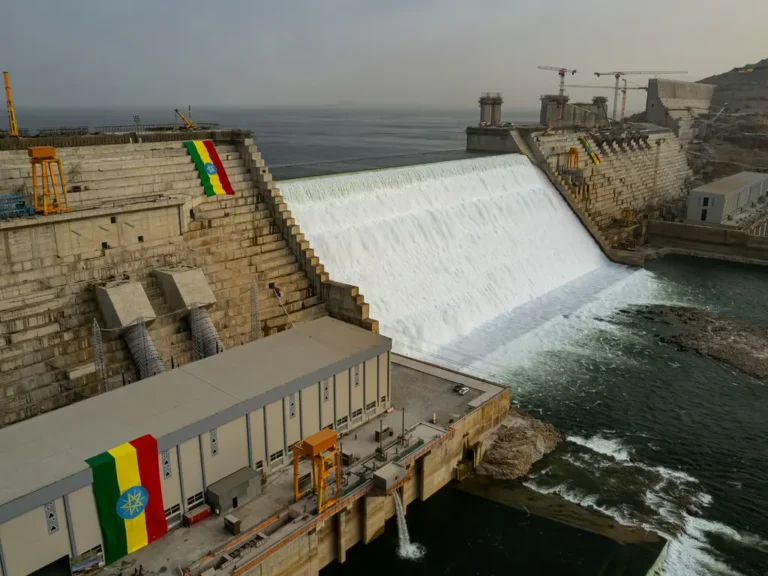
Cairo, Egypt – An international scientific study has highlighted potential technical and geological risks associated with the Grand Ethiopian Renaissance Dam (GERD). The study focused particularly on the section known as the “saddle dam,” a pivotal element in the project’s storage system. This section directly impacts the dam’s reservoir capacity.
Indicators of land subsidence and water seepage
The study, which involved researchers from Egypt, China, India, the United States, and Nepal, revealed land subsidence of up to 40 millimeters in some areas of the Saddle Dam, along with the detection of unexpected water accumulations near the dam. The study also projected potential pathways for water to seep into the aquifer, with a volume of up to 41 billion cubic meters occurring during the various stages of reservoir filling. This could affect storage efficiency and the stability of the rock foundations.
Seismic activity and reservoir effects
The study noted the coincidence of local seismic activity with the reservoir’s filling phases, a phenomenon known as reservoir-induced seismicity. This could activate existing fault lines and increase the risk of geological movements in the region. Researchers emphasized that any malfunction or partial collapse of the Saddle Dam could result in powerful flood waves reaching Sudan. There is also the potential for subsequent impacts on Egypt.
The importance of transparency and oversight
Abbas Sharaki, a professor of water resources at Cairo University, emphasized the importance of enhancing monitoring and transparency in publishing engineering studies and reports related to the Grand Ethiopian Renaissance Dam (GERD), especially with the approaching heavy rainy season expected in July, which could increase pressure on the reservoir.
Strengthening risk management efforts
Sharaki emphasized that Egypt has benefited from the High Dam, desalination projects, and well drilling to maintain Lake Nasser’s water reserves and compensate for some of the water loss. He also stressed the need for continuous monitoring of the Grand Ethiopian Renaissance Dam’s (GERD) technical and geological status to ensure the stability of downstream countries and protect their water resources.
This study reaffirms the critical need for ongoing risk assessments of the GERD. Furthermore, international cooperation must be ensured to mitigate the potential impacts of any emergency scenario on Egypt and Sudan.