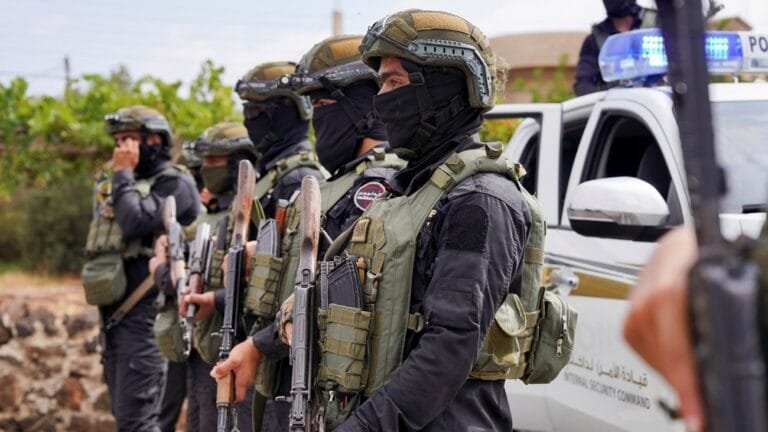
Damascus, Syria – Syrian security forces began a large-scale deployment operation on Wednesday inside the al-Hol camp in the northeast of the country. The camp houses thousands of families affiliated with ISIS. This move comes a day after Kurdish forces announced their withdrawal from the camp and from large areas with an Arab majority. Furthermore, Kurdish forces have fortified their main strongholds in Hasakah province.
Scenes from the field: Handover
Field reporters observed dozens of Syrian security personnel opening the iron gates of the fenced camp. They then entered with their military vehicles to secure the site, which houses approximately 24,000 people, including 6,300 foreigners (women and children) from 42 different nationalities. Meanwhile, international concerns have arisen regarding the repercussions of this security vacuum.
Kurdish withdrawal and the call of “Abdi”
This deployment came after the commander of the Syrian Democratic Forces (SDF), Mazloum Abdi, decided to withdraw his fighters toward predominantly Kurdish areas. He emphasized that protecting these areas was a “red line.”
A message to the coalition: Abdi called on the US-led international coalition to assume its responsibilities regarding facilities holding ISIS members. He also warned of the dangers left by the recent withdrawals.
The American position: In contrast, Washington announced that the Kurds’ mission to confront the organization had ended, after years of military and logistical support.
The faltering political process and the escalation on the ground
Despite both parties (Damascus and the SDF) announcing their commitment to a ceasefire and exploring ways to integrate civilian and military institutions within the framework of the Syrian state, the reality on the ground reflected a different picture:
Government forces advance: Syrian security forces and the army have established control over areas in Raqqa and Deir ez-Zor. They have also sent significant reinforcements towards the city of Hasakah.
The negotiations collapsed: Each side accused the other of violating the agreement brokered by President Ahmed al-Sharaa. According to Kurdish officials, this led to the “collapse of negotiations” and a return to square one.
Background: The latest military offensive in Aleppo began on January 6th. This led to a fragile settlement stipulating the complete integration of the self-administration institutions. It is worth noting that this settlement now faces a real test on the ground in light of the shifting balance of power.