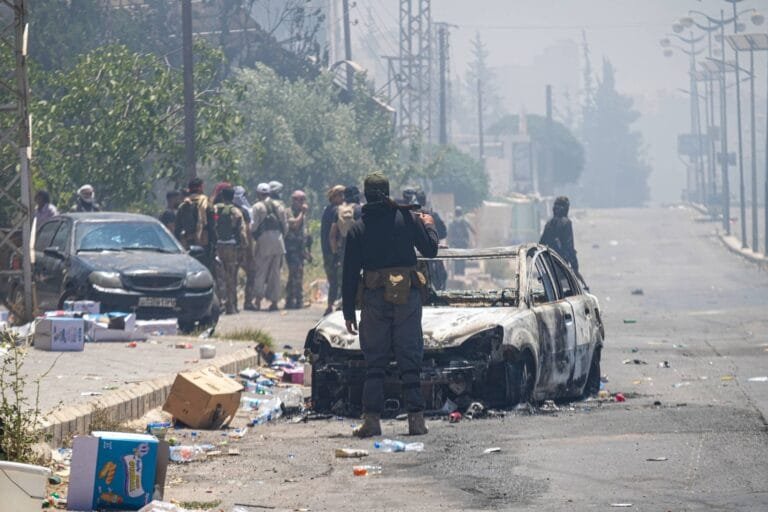
Aleppo, Syria – Clashes between government forces and the Syrian Democratic Forces (SDF) in Aleppo left five people dead on Tuesday, according to Syrian state media. The renewed fighting came two days after a new round of negotiations held on Sunday in Damascus. According to the Kurds, the talks addressed the integration of their forces into the Syrian army but failed to produce any tangible results.
Amid months of stalled negotiations between the two sides, clashes between government forces and the SDF in the northern Syrian city of Aleppo resumed on Tuesday, resulting in the deaths of five people, including four civilians.
In this context, Syrian state media reported the death of a member of the Ministry of Defense and two women as a result of shelling by the Syrian Democratic Forces (SDF) on neighborhoods in Aleppo. Meanwhile, Kurdish forces reported the death of a civilian from the predominantly Kurdish Sheikh Maqsoud neighborhood.
Despite signing an agreement in March stipulating the integration of the self-governing institutions established by the Kurds during the years of conflict into the Syrian state, the two sides engage in intermittent but deadly clashes, particularly in Aleppo, which includes two predominantly Kurdish neighborhoods.
In a statement issued Tuesday morning, the Syrian Democratic Forces accused “armed factions affiliated with the interim Ministry of Defense” of “targeting the Sheikh Maqsoud neighborhood” in Aleppo with a reconnaissance aircraft, resulting in “the martyrdom of a citizen from the neighborhood and the injury of two others.”
In another statement, factions affiliated with the Syrian army were accused of shelling the city of Deir Hafer, located about 50 kilometers east of Aleppo, and the area surrounding the strategic Tishrin Dam northeast of Aleppo, “with mortars and heavy weapons.” The US-backed forces asserted that they “possess the legitimate right to respond to these attacks in defense of our people and to preserve the security and stability of our regions.”
For its part, the local authorities in Aleppo province accused the Syrian Democratic Forces (SDF) of “a new violation of the agreements signed with the government” after “targeting the area near the Shihhan roundabout” in the city, resulting in “the death of one member of the Ministry of Defense and the injury of three others.” Later, the official SANA news agency reported the deaths of “three civilians, including two women,” as a result of SDF shelling of “residential buildings in the al-Midan neighborhood.”
This is not the first time the two sides have engaged in bloody clashes. On December 22, similar clashes broke out, hours after a visit by Turkish Foreign Minister Hakan Fidan to Damascus, during which he urged Kurdish forces “not to become an obstacle to the unity of Syrian territory and its long-term stability.”
The Ministry of Health at the time reported the deaths of four civilians as a result of shelling by the Syrian Democratic Forces, who in turn reported the death of a woman due to government shelling. The renewed clashes on Tuesday came two days after a new round of negotiations held on Sunday in Damascus. According to the Kurds, the talks discussed the integration of their forces into the army, but, according to state media, failed to achieve “tangible results.”
Over the past period, the two sides have exchanged accusations of obstructing efforts to implement the agreement signed by the commander of the Syrian Democratic Forces, Mazloum Abdi, and President Ahmed al-Sharaa on March 10. Its implementation was supposed to be completed by the end of 2025, but differing viewpoints between the two sides have prevented progress, despite pressure led primarily by Washington.
Kurdish forces control vast areas of northern and eastern Syria, including major oil and gas fields. They spearheaded the fight against ISIS and, with the support of the US-led international coalition, drove the group from its last strongholds in the country in 2019. Following the overthrow of Bashar al-Assad’s regime, the Kurds showed flexibility toward the new government and raised the Syrian flag in their areas. However, their insistence on a decentralized system of governance and the enshrining of their rights in the constitution has fallen on deaf ears in Damascus.