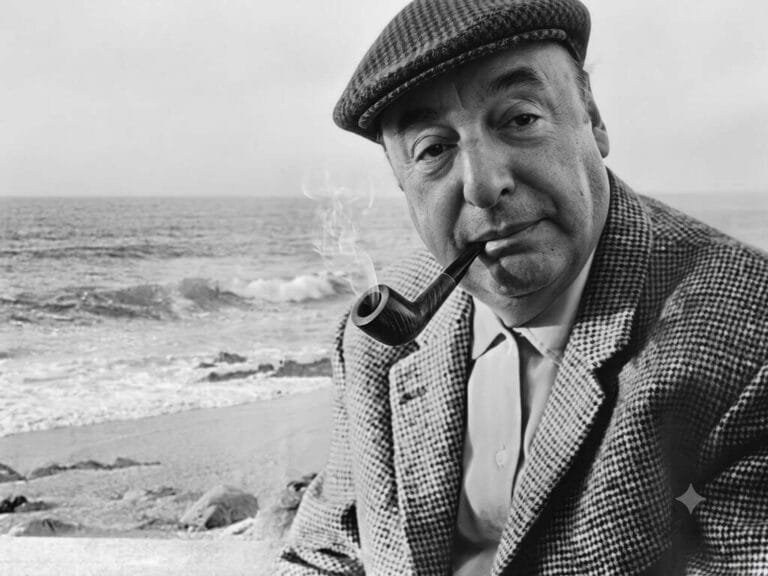
Santiago – Chilean poet Pablo Neruda remains one of the most prominent literary figures to have shaped the consciousness of the 20th century. Neruda was not merely a poet of love and romance; he was an epic human voice in which the romanticism of language merged with the harshness of political struggle, making his poems icons of freedom and social justice. Decades after his passing, his life and death remain a mystery that continues to spark debate, just as his life was filled with transformations and contradictions.
From “Parral” to Global Renown: The Birth of a Poet
Neruda was born under the original name “Ricardo Eliécer Neftalí Reyes Basoalto” on July 12, 1904, in the Chilean city of Parral. From his earliest youth, his literary talent proved advanced for his age, prompting him to adopt the name “Pablo Neruda”—a name that later became his legal identity—to map out a literary path with no known boundaries.
Evolution of Experience: From Love to Epic
Neruda etched his name into the annals of literary immortality early on with his famous collection “Twenty Love Poems and a Song of Despair,” which became a milestone in Spanish literature. Yet, his genius did not stop at the limits of emotion; his experience evolved to engage with the great human issues, using poetry as a weapon against injustice and tyranny. This was clearly reflected in his epic work, “Canto General,” which embodied the history and suffering of Latin America.
The Diplomat Politician: Struggle in the Halls of Power
Neruda was not just a witness to his era; he was a maker of its events. He engaged in politics as a senator, joined the Communist Party, and represented his country in high-level diplomatic posts. His bold political stances brought him into conflict with power, leading to persecution and exile before he could return. In 1971, his global journey culminated in the Nobel Prize in Literature, in recognition of a poetic power that captured the full range of the human experience.
The Mystery of Departure: A Death That Sparks Debate
Pablo Neruda passed away on September 23, 1973, just days after the military coup led by General Augusto Pinochet that overthrew President Salvador Allende. While the official narrative declared the cause of death as “cancer,” suspicions held by Neruda’s family and associates persisted regarding the possibility of poisoning due to his influential political role. Over the years, multiple scientific and judicial investigations were conducted, yet the case remained suspended in a space of scientific and political debate without reaching a definitive, consensus-driven conclusion.
An Eternal Legacy
Pablo Neruda remains present in the human conscience, not only as a poet who sang for nature and love, but as a voice that defended human dignity. His works, translated into dozens of languages, are still read today as an eternal literary document, affirming that the true poet is not one who merely describes the world, but one who seeks to change it through words that refuse to break.