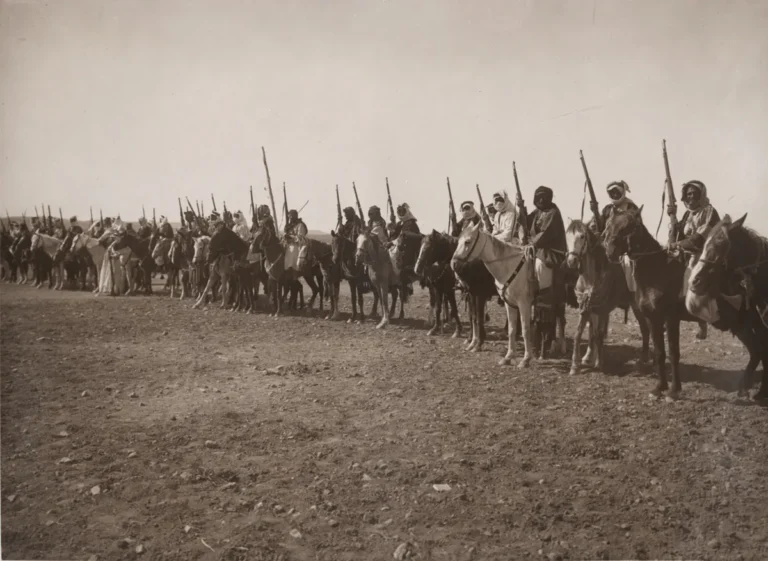
The Great Arab Revolt is considered one of the most prominent milestones in the history of the Arab region during the twentieth century. Its spark was ignited in June 1916 under the leadership of Sharif Hussein bin Ali, Sharif of Makkah. The revolt aimed to end Ottoman rule in Arab lands and establish an independent Arab state, taking advantage of the complex geopolitical conditions imposed by World War I, which witnessed a massive conflict between major international powers.
Roots of Tension and Rising Nationalist Sentiment
The revolt erupted as a result of years of escalating tension between Arab leaders and the Ottoman government. This was due to the strict centralist policies pursued by Istanbul, in parallel with the growing Arab nationalist sentiment and the desire of many leaders to obtain a greater degree of political and administrative independence from the empire. These factors combined were the fuel that drove the Arab elite and tribes toward action to claim sovereignty and self-determination.
The Start of the Revolt and the Military Path
Sharif Hussein bin Ali announced the start of the revolt from Makkah, where Arab forces raised the banner of the revolution and began their military operations by taking control of a number of cities in the Hejaz. The confrontations later extended to other regions with the support of Arab tribes and Arab officers who joined the revolt. This movement received British support within the context of World War I, as London provided money, weapons, and military advisors, most notably the British officer Thomas Edward Lawrence, known as “Lawrence of Arabia,” who contributed to military coordination with Arab forces.
The forces of the revolt were able to achieve a series of strategic victories, the most important of which was the capture of the city of Aqaba in 1917, followed by effective participation in the advance toward the Levant. These efforts culminated in the entry into Damascus in 1918, coinciding with the collapse of the Ottoman front in the region and the approaching end of World War I, which opened a new chapter in the history of the region.
Arab Ambitions Clash with Secret Agreements
Despite field military successes, the ambitions of the revolt’s leaders clashed with the political reality represented by the secret agreements concluded by the victorious European powers. At the forefront of these agreements were the Sykes-Picot Agreement and the Balfour Declaration, which led to the partition of many Arab lands and placing them under the British and French Mandate system. This caused the loss of the dream of establishing a unified Arab state that the leaders of the revolt had hoped for, and imposed a new geopolitical reality on the region.
The Historical Impact of the Revolt on the Region
Historians consider the Great Arab Revolt a major turning point in the history of the modern Middle East. It contributed to ending centuries of Ottoman rule in large parts of the Arab region, and had a direct impact on drawing the modern political borders of a number of Arab countries as we know them today. The events of this revolt and its political and social results remain a subject of wide historical and analytical discussion, as it is considered the primary founder of the concept of the modern Arab nation-state.