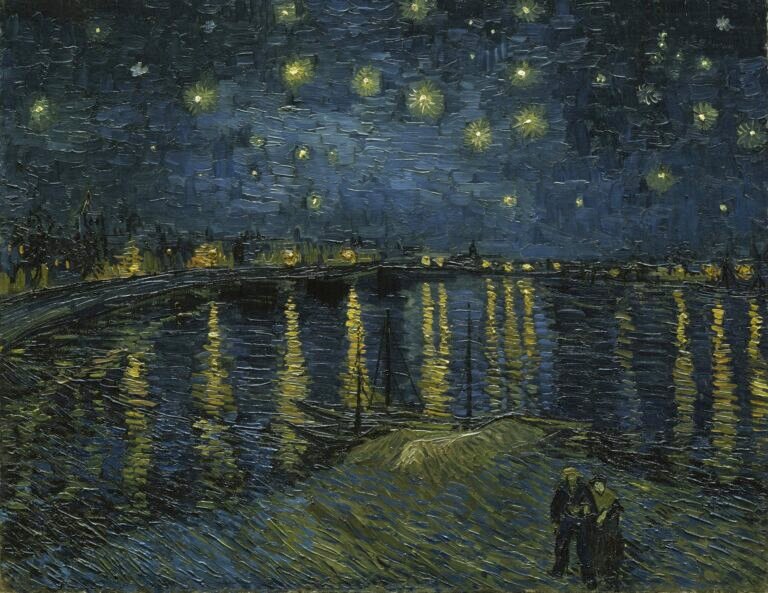
Amsterdam, Netherlands – The painting “The Starry Night” is considered one of the most famous and influential works of art in human history today. Despite this global status, the Dutch painter Vincent van Gogh was not satisfied with it when he completed it. He considered it a work below his artistic ambitions. Also, he did not place it among his greatest achievements during his lifetime.
Behind the Scenes of the Masterpiece
Van Gogh painted the work in 1889 while staying at an asylum in the French town of Saint-Rémy. The artist was receiving treatment for psychological disorders that impacted his life and artistic output. He was inspired by the view from his window. Therefore, he depicted a swirling sky with luminous vortices and colors that later became a hallmark of his unique style.
Letters exchanged between the artist and his brother Theo reveal that Van Gogh did not view the painting as one of his best works. He felt it deviated from the realism he sought in other paintings. Furthermore, he believed some of its elements relied more on imagination and personal perception than direct observation of nature.
Harsh Self-Evaluation and History’s Verdict
Art historians point out that Van Gogh was extremely harsh in evaluating his work, often questioning the quality of his output despite his exceptional talent. The artist did not witness the global fame his works later achieved. He passed away in 1890, far from the status he holds today in global art history.
Over the decades, “The Starry Night” has become a global artistic symbol, studied and analyzed in museums and academies. Critics argue that the work embodies Van Gogh’s unique vision and his ability to transform natural scenes into deep visual and emotional experiences.
An Eternal Legacy Beyond Time
The painting has inspired generations of artists and creators, becoming a part of global popular culture. Art experts emphasize that the story of “The Starry Night” reflects a striking paradox in the history of creativity. While its creator viewed it as an experiment that did not meet his aspirations, the world later saw it as one of the greatest and most influential paintings produced by the human mind.
The painting remains a testament that an artist’s evaluation of their work at the moment of completion may differ greatly from history’s verdict. Some works viewed as ordinary or even failures by their creators can evolve into timeless masterpieces.