
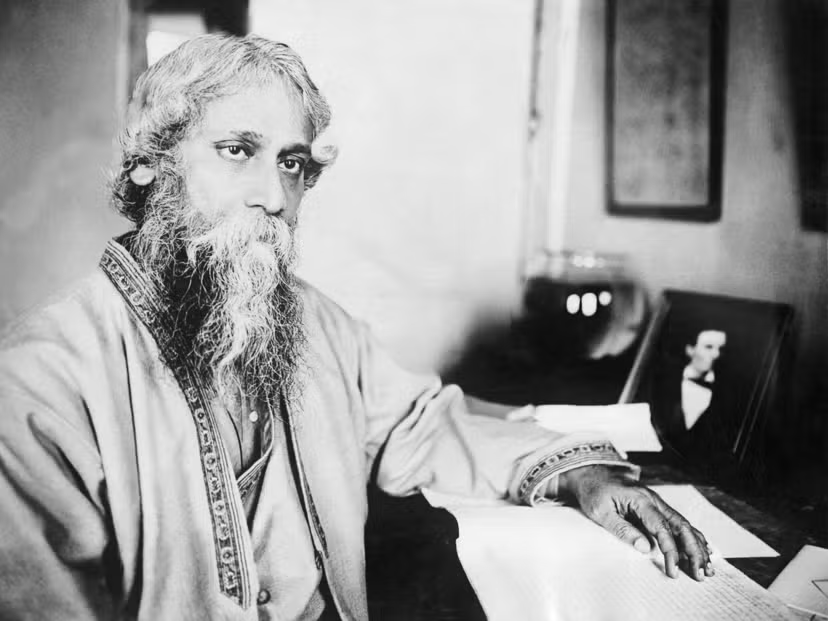
Stockholm – Agencies – In 1913, the Swedish Academy announced the awarding of the Nobel Prize in Literature to the Indian poet and thinker Rabindranath Tagore. This moment represented a historical turning point in the prize’s journey, as Tagore became the first writer from outside Europe to receive this high honor. Furthermore, the Academy introduced Tagore at the time as a deeply human poetic voice that transcends geographical borders. Accordingly, the name of the author Rabindranath Tagore became associated with the values of tolerance and spiritual philosophy that dazzled both West and East. In this regard, the world began to look with greater appreciation at creativity coming from Asia at the dawn of the twentieth century.
Gitanjali and the Indian Spirit Crossing from Locality to Universality
The Swedish Academy presented Tagore’s works as a bridge connecting different cultures through spiritual meditation and poetry. Obviously, his famous collection “Gitanjali” was the primary reason behind this unique global coronation. As a result, the author Rabindranath Tagore was able to carry the pure Indian spirit from a narrow local scope to a vast global reach. In addition, his writings brilliantly blended deep philosophy with simple wording, making them close to the hearts of readers worldwide. However, the core of his creativity remains in his ability to address the common human conscience with honesty and transparency.
Exceptional Poetic Sensitivity Reframing the Relationship Between Man and the Universe
In its founding statement for the prize, the Academy confirmed that Tagore’s writings embody an exceptional poetic sensitivity previously unknown to world literature. Certainly, his ability to reframe the relationship between man and the universe in spiritual language was admired by the judging committees. Accordingly, this award placed Indian literature for the first time on the map of official international recognition. On the other hand, the win of the author Rabindranath Tagore opened the door wide for later generations of Asian and African writers to reach major coronation platforms. In the same context, critics believe that Tagore succeeded in proving that true creativity does not recognize ethnic or national identity.
A Defining Moment Breaking the Dominance of Traditional European Borders on Literature
agore’s win in 1913 is viewed as a defining moment that did not just honor a great poet, but changed the face of literary history. Obviously, this choice provided the world with an entirely new perception of literature outside traditional European borders and patterns. As a result, the Nobel Prize transformed from a regional award focusing on the West to a global prize encompassing all spectra of human creativity. In addition, this win strengthened the status of the author Rabindranath Tagore as an immortal cultural icon whose work literature students still study to this day. Ultimately, Tagore will always remain the voice that broke the silence and let the world hear the sad and beautiful melody of the East.