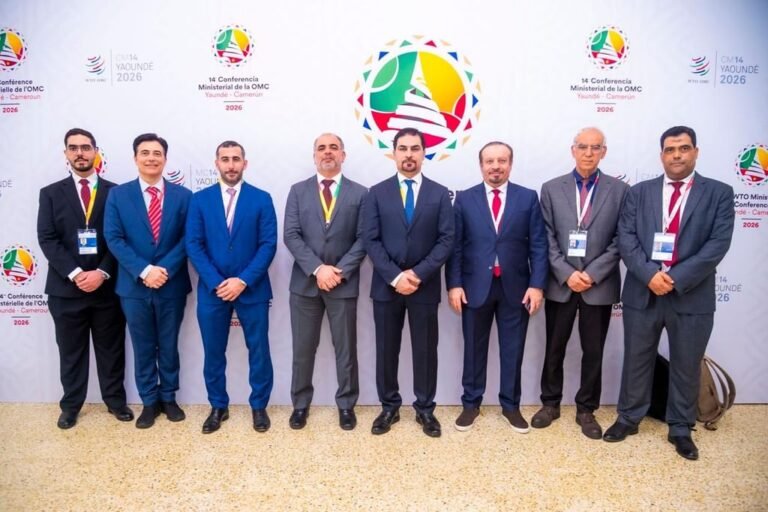
Yaounde, Cameroon – The UAE reaffirmed its continued contribution to mobilizing international efforts to adopt a rules-based multilateral trading system. As a key driver of sustainable economic growth around the world. Especially in light of the unprecedented challenges currently facing the global trading system due to geopolitical tensions and the rise of protectionism, with all its negative impacts on global supply chains and the cross-border flow of goods and services.
This came during the country’s delegation’s participation in the Fourteenth Ministerial Conference of the World Trade Organization (MC14), which was hosted by Cameroon during the period from 26 to 29 March.
Growing status
The UAE’s active participation in this important international event reflects the growing position that the country now occupies as a major actor in shaping the features of the future of global trade. Especially after successfully hosting the organization’s thirteenth ministerial conference in the UAE capital, Abu Dhabi, in early 2024. The resulting outcomes contributed to consolidating the positive role of the UAE – as the host country – in shaping the future of international trade towards greater openness and common prosperity.
The UAE’s participation in the Fourteenth Ministerial Conference has a new dimension in light of the rapid developments witnessed by the global trading system. At a time when the risks associated with trade wars and customs duties imposed by some major countries are increasing, and barriers to the flow of goods globally are increasing. The UAE stands out as a moderate voice calling for maintaining an open, rules-based trading system.
practical steps
This call was not only theoretical, but the state translated it into concrete practical steps. The UAE recently joined the Future Investment and Trade Partnership (FIT) initiative. Which includes 14 countries that believe that the principles of free trade represent a fundamental pillar of stability and prosperity.
In addition to the UAE, the founding group includes: Brunei, Chile, Costa Rica, Iceland, Liechtenstein, Morocco, New Zealand, Norway, Panama, Rwanda, Singapore, Switzerland, and Uruguay.
Members of this international partnership work to cooperate on a wide range of vital trade issues. These include strengthening supply chains, removing non-tariff barriers to trade, supporting foreign direct investment, and adopting and integrating emerging technologies.
These priorities are expected to form a central focus of the agenda of the 14th Ministerial Conference, as the UAE seeks to translate this partnership into tangible results that enhance the efficiency and effectiveness of the multilateral trading system.
mobilizing international support
During participation in the Fourteenth Ministerial Conference of the World Trade Organization, the UAE delegation was keen to emphasize that measures restricting trade at the global level threaten to fragment the global economy, weaken economic growth, and increase inflationary pressures and unemployment rates.
From this standpoint, the UAE renewed its call at the conference to mobilize international support to maintain the flow of trade and enhance the resilience of the global economy in the face of shocks.
During its active participation in the conference, the country’s delegation also highlighted the UAE’s development model, affirmed the country’s commitment to the principles of economic multilateralism, and strengthened international partnerships in light of the delicate stage that global trade is going through.
strengthen bilateral relations
At the level of bilateral relations, the UAE’s participation in this important international forum was distinguished by its ability to combine multilateral action with strengthening bilateral relations. The UAE continued to explore opportunities to expand its network of trading partners, by taking advantage of its distinguished geographical location and advanced infrastructure. He also discussed new horizons for trade cooperation with African countries, especially with the conference being held in the African continent, which is witnessing increasing economic growth.
On the sidelines of the conference, the UAE delegation held a series of bilateral meetings with representatives of Austria, The Bahamas, New Zealand, Peru, Guatemala, and others.
The Ministerial Conference is the highest decision-making body in the World Trade Organization, and brings together trade ministers and senior officials from the 166 member states.
This year’s session is of exceptional importance, as it is the second session hosted by an African country after the tenth conference in Nairobi, Kenya in 2015, which highlights the growing interest in the role of the African continent in the multilateral trading system.