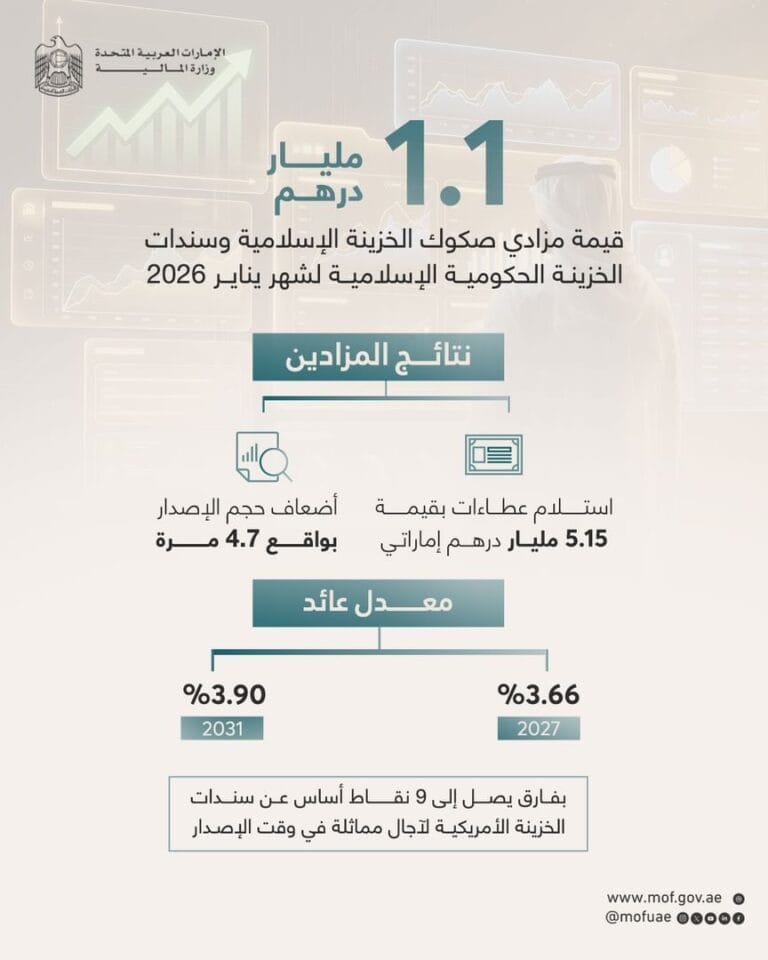
Abu Dhabi, UAE – The Ministry of Finance, in its capacity as the issuer, and in cooperation with the Central Bank of the United Arab Emirates, in its capacity as the issuing and payment agent, announced the success of the auction of Islamic treasury bonds “T-Sukuk” and government treasury bonds “T-Bonds” denominated in the UAE dirham, for the month of January 2026, with a total issuance value of 1.1 billion dirhams.
These issuances represent the first offerings within the Sukuk and Bonds Programs for the year 2026, as published on the Ministry’s official website.
The new issuance of treasury bonds represents the first tranche to be offered under the program since March 2023.
Which supports the development of the yield curve and enhances the depth of the secondary market.
The sukuk and bond auctions witnessed strong demand from banks dealing in the sukuk tranche due in October 2027 and the new tranche for bonds due in January 2031.
The total value of the submitted bids amounted to 5.15 billion UAE dirhams.
Equivalent to about 4.7 times the version size.
This high demand reflects investors’ confidence in the strength of the country’s financial sector and the strength of the national economy.
The issuance’s success is highlighted by competitive prices based on market mechanisms, which were achieved at a rate of return to maturity (YTM) of 3.66% for the sukuk segment and 3.90% for the bond segment.
This is a small difference of 9 basis points from the yields of US Treasury bonds with similar maturities for the two tranches at the time of issuance.
The sukuk and bond tranches will also be listed on Nasdaq Dubai, enhancing ease of access for investors in the secondary market.
The releases reflect the continued growth of both programs.
The total outstanding balance amounted to 28 billion dirhams, distributed over maturities from two to five years.
It should be noted that the local currency sukuk and bond programs work to build a return curve denominated in the UAE dirham, and provide safe investment alternatives to investors.
This contributes to enhancing the competitiveness of the domestic debt capital market, improving the investment environment, and supporting sustainable economic growth.