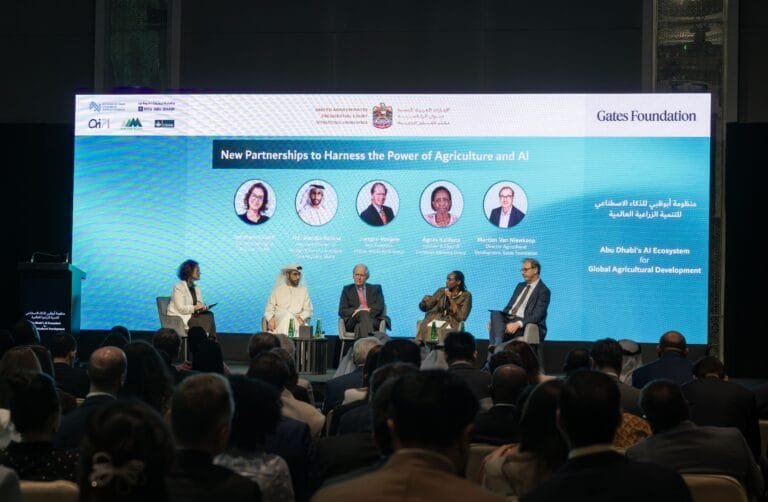
Abu Dhabi, UAE – During an international dialogue session held in Abu Dhabi, on the sidelines of the launch of the “Artificial Intelligence System for the Global Agricultural Sector” platform, global leaders and experts in the fields of agriculture and modern technologies discussed the role of artificial intelligence in promoting sustainable agriculture and the resilience of food supply chains.
The speakers stressed that artificial intelligence enhances the ability to confront agricultural challenges efficiently and intelligently.
By providing accurate information to small farmers and policymakers, and compiling disparate data to provide practical tools that support governments, research, and the private sector.
They pointed out that partnerships between governments, scientific institutions, universities and development partners have proven effective in the past two years.
This is achieved by launching four major initiatives under the leadership of the UAE.
This reflects the state’s pioneering role in artificial intelligence and agriculture.
Regarding “the role of artificial intelligence in water and agriculture management,” His Excellency Abdullah Al-Ala, Assistant Minister of Foreign Affairs for Energy and Sustainability Affairs, said that water is the lifeblood of agriculture, and that 70% of fresh water is consumed in this sector, which requires wise management of water resources.
He explained that artificial intelligence and future technologies contribute to predicting weather conditions and addressing desertification and water disasters such as floods, lack of rain and groundwater depletion, and that the United Nations Water Conference will provide an opportunity to apply these technologies in smart agriculture and support decision-makers in monitoring issues such as sea level rise and improving decision-making.
Linking farmers to policies and the private sector
Regarding “the role of artificial intelligence in promoting smart agriculture programs globally”, Jürgen Volkling, Vice President of the World Bank Group for Agriculture, stressed its ability to integrate small farmers into agricultural value chains, and provide integrated information that includes weather, prices, and pest control.
He pointed to the AgriConnect program, which connects farmers with politics and the private sector.
He stressed that cooperation between governments and international institutions is essential to achieve broad and sustainable impact.
While accelerating research, data analysis, and supporting productive and financial decision-making.
Regarding “the importance of open data and global infrastructure”, Martin van Neukop, Director of Agricultural Development at the Gates Foundation, pointed out that artificial intelligence constitutes a global infrastructure for transforming agricultural knowledge into practical services.
This is while ensuring that data and models are available as global public goods to ensure that recommendations and guidance reach hundreds of millions of small farmers by 2030.
He stressed that partnerships between the UAE, international research institutions and the World Bank contribute to enabling farmers to obtain agricultural knowledge and tools comprehensively and on a large scale.