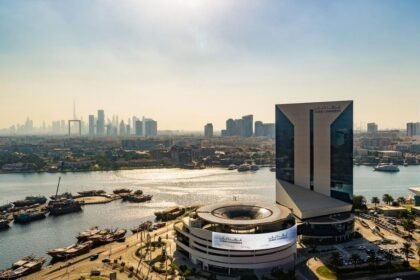
Dubai, United Arab Emirates – The Dubai Future Foundation has unveiled an innovative project that uses artificial intelligence technologies to measure the impact of tree cooling in Dubai and cities around the world.
The project was developed at the Sensible City Laboratory in Dubai, supervised by Dubai Future Laboratories, and was launched in cooperation with the Massachusetts Institute of Technology in 2023 to be the first Sensible City laboratory in the Middle East.
The innovative project (Re-Leaf) was displayed at the 19th International Architecture Exhibition “Biennale 2025” hosted by Venice, Italy.
The project employs computer vision techniques, artificial intelligence-based analysis of satellite images and thermal imaging of more than 2,000 trees, to create the first comparative urban vegetation dataset in Dubai, Amsterdam, Los Angeles and Rome.
This display includes skyscraper-like structures that represent the levels and percentage of greenery in these cities, in a striking visual embodiment that highlights the crucial role of trees and urban forests in confronting rising global temperatures.
Scalable platform
The project’s importance lies in providing a scalable, data-driven platform to enable cities to harness natural cooling systems in light of the worsening effects of climate change and the increasing intensity of heat waves.
Studies have shown that trees may be up to 15 degrees Celsius cooler than their surrounding surfaces, with local drought-resistant trees significantly superior.
This idea is especially important in dry areas such as the UAE.
High temperatures and water scarcity impose an urgent need to develop more efficient climate solutions.
Khalifa Al Qama, Director of Dubai Laboratories for the Future, affiliated with the Dubai Future Foundation, said that participation in this important future project comes from the Foundation’s belief in the importance of participatory scientific research and the employment of advanced technologies and strategic partnerships to develop new solutions that support the resilience of cities and their readiness to face future challenges.
He added that the project confirms that green spaces are one of the most important pillars of the basic infrastructure of future cities, and that the Foundation aims through it to serve the entire world by providing global solutions for sustainable urban living to serve communities and ensure the quality of life of their members in light of the major changes that the world is witnessing at all levels.
In turn, Carlo Ratti, director of the Sensible City Laboratory at the Massachusetts Institute of Technology, said that the world is witnessing a continuous and noticeable rise in temperatures, which has made it necessary to view trees as a major pillar of infrastructure and not just an aesthetic element.
He pointed out that the development of artificial intelligence applications has enhanced the ability to measure the impact of the role of trees and vegetation cover on climate cooling with high accuracy.
He also stressed that trees are a natural and effective solution to combat global warming.
It is worth noting that the Sensible City Lab, launched by the Dubai Future Foundation in partnership with the Massachusetts Institute of Technology (MIT), works to develop and employ the latest advanced technologies to enhance the quality of life in the city of Dubai.
In addition to testing actionable ideas in the era of the digital revolution, and diagnosing the most important current and future challenges.
In addition to employing technologies and data, which are the communication backbone of the digital city, and using data to achieve Dubai’s ambitious goals, in line with its future strategies.
The laboratory also conducts interdisciplinary research, tests pilot projects, develops knowledge, methods, and tools to increase understanding of the natural and architectural environment, and innovates appropriate solutions to urban challenges.