
Washington, DC – Artificial intelligence (AI) has made remarkable progress in mathematics, helping to solve problems that have remained unsolvable for decades.
This development reflects the expanding capabilities of modern models to discover
patterns and relationships that are difficult for humans to access using traditional methods.
Some of these problems date back decades, and mathematicians
have been trying to find solutions or understand their structure
without reaching conclusive results. However, AI tools have begun to offer new approaches to tackling them.
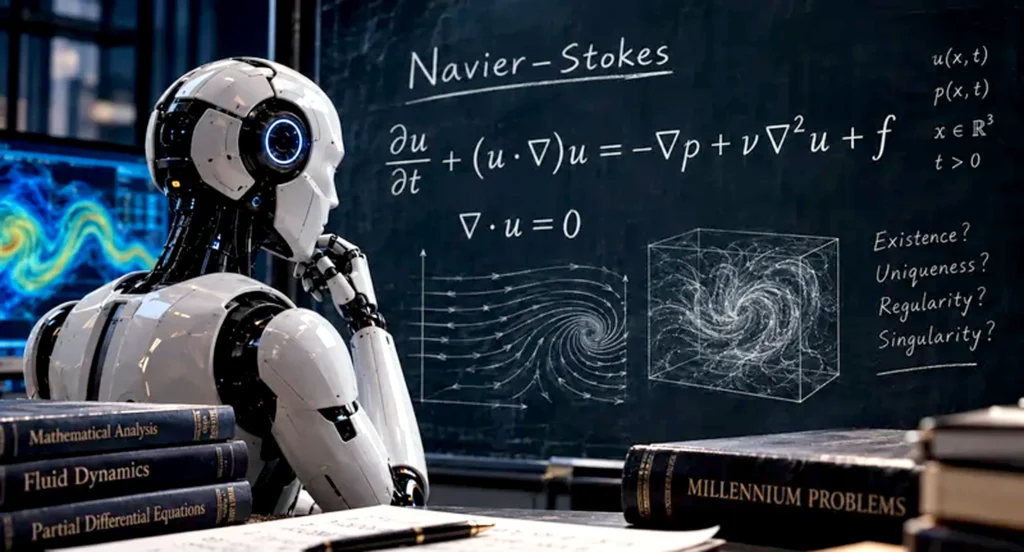
What did he discover? (Photo/Archive)
The role of artificial intelligence in performing calculations
In these cases, artificial intelligence’s role extends beyond simply performing calculations quickly.
It also involves searching for mathematical patterns and proposing new hypotheses
and approaches that researchers can test and validate.
This development is particularly important because mathematics relies heavily on discovering subtle relationships.
AI systems can accomplish this by analyzing vast amounts of probabilities and data in a short time.
Researchers believe these tools do not replace mathematicians.
Rather, they can become research partners, helping mathematicians arrive at new ideas.
Researchers then take on the task of examining and proving these ideas according to established mathematical principles.
What did he discover? (Photo/Archive)
Combining human creativity with immense computing power
These technologies could also transform the way mathematical
research unfolds in the future, shifting from complete reliance on intuition
and human experience to a model that combines human creativity with immense computing power.
However, arriving at a correct result with the help of artificial intelligence
does not necessarily equate to possessing an acceptable mathematical proof.
Verification and validation of results remain essential steps
before any discovery can be considered a complete mathematical achievement.
This progress opens the door to a new era of human-machine collaboration.
This era may help to re-examine problems that have challenged mathematicians for decades,
while simultaneously revealing potential that was not apparent in the early days of artificial intelligence.