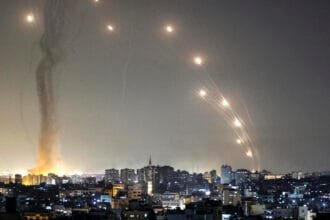

Cairo, Egypt – Amid escalating regional and international tensions, attention is turning to the deeper dimensions of the US-Israeli war on Iran. It is not merely a conventional military confrontation.
Rather, it reflects structural shifts in the international system and a reshaping of the global balance of power.
The nature of international competition
In this context, Dr. Mohamed Mohsen Abu El-Nour, a member of the Egyptian Council for Foreign Affairs,
stated that the current conflict reflects “a qualitative shift in the nature of international competition,
which is no longer limited to the military dimension. It now extends to include the restructuring of global influence and trade and energy routes.”
Strategic corridors at the heart of the conflict
Abu Al-Nour added, during a seminar hosted by the Egyptian Public Library,
that “the ongoing confrontation carries within it a hidden conflict over strategic waterways.
Foremost among these is the Strait of Hormuz.
Additionally, international powers are seeking to reshape alternative waterways.”
US-China rivalry for global leadership
He explained that “China has become a major player seeking to share leadership of the international system,
in contrast to the United States, which is working to maintain its dominance.”
This directly impacts the nature of the conflict with Iran.
Iran is a significant geopolitical player
He pointed out that “Iran represents a crucial geopolitical hub within the global network of waterways.
This makes it a target for attempts to rebalance or diminish its role.”
This is not only due to its nuclear or missile programs.
It is also because of its pivotal position in the international energy and trade equation.
Intertwining of military and economic tools
Abu al-Nour emphasized that “the interplay between military
and economic tools has become a key feature of modern conflict management,
with hard power being used as a means to reshape trade balances and global influence.”
This comes amidst escalating competition between major powers.
Shifts in Iran’s international positioning
He added that “Iran’s accession to the Shanghai Cooperation Organisation
and the BRICS group within a short period of time reflects a strategic shift in its orientation.”
It also strengthens its position within blocs that rival the West.
Navigation threats and global impacts
He also pointed out that “the current escalation has direct repercussions on international shipping,
given the threats associated with the Strait of Hormuz and the Bab el-Mandeb Strait.”
This could significantly impact energy supplies and global trade.
Thus, the crisis acquires an international dimension that transcends regional boundaries.
A pivotal moment in the international system
Abu al-Nour concluded his remarks by emphasizing that “the current situation reflects
a pivotal moment in the history of the international system,
in which geopolitical transformations are accelerating at an unprecedented rate.”
This necessitates a profound analysis. It should transcend traditional interpretations of the conflict.