Cairo, Egypt – Amidst US military movements in the Arabian Gulf region, Iranian affairs expert Abdul Rahman Wajdan revealed details of a well-defined US military plan that is beginning to take shape on the ground against Tehran. Wajdan told Voice of the Emirates that the United States has launched extensive and comprehensive preparations for a significant military operation. These preparations were clearly demonstrated by the arrival of two additional B-52 bombers at the British base of Fairford last Saturday.
massive military buildup
According to the researcher’s data, the total number of B-52 strategic bombers stationed in the region has risen to 23. This massive air buildup coincides with a significant presence of US amphibious forces and Marines, reinforcing the hypothesis of imminent action. Wajdan considered the deadline set by Trump for Iran to refrain from targeting vital infrastructure and energy facilities as a clear indication of a military plan ready for implementation.
Operation “Arc of Islands”
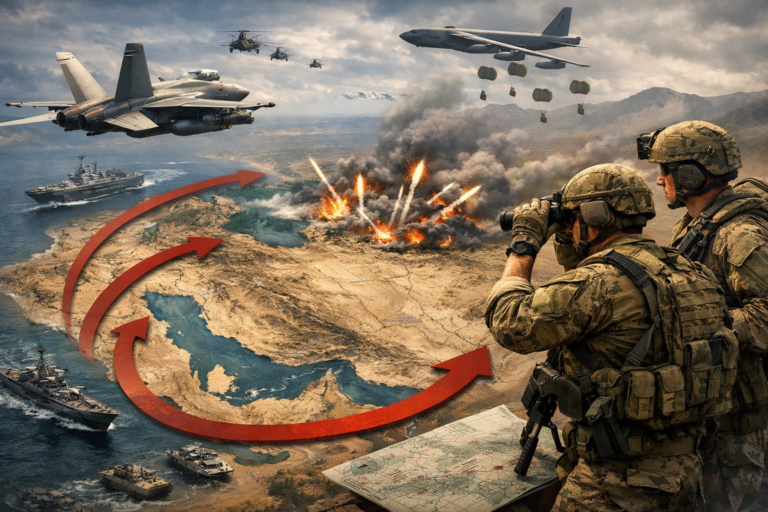
Regarding the operational details, Wajdan explained that the plan relies primarily on launching intensive and focused airstrikes directly targeting the Iranian coast. These strikes are expected to be followed by large-scale air and ground operations aimed at achieving complete control over what is known as the strategic Iranian “arc of islands.” The targeted islands in the Arabian Gulf include Kharg Island, Qeshm Island, Larak Island, and Hengam Island, as well as the occupied Emirati islands of Abu Musa, Greater Tunb, and Lesser Tunb. These military operations and the ground landing on the coast aim to ensure absolute dominance over these vital locations and to secure them permanently.
Motives for escalation
Researcher Abdul Rahman Wajdan attributed this American move to several crucial factors, most notably Iran’s continued intransigence and its categorical refusal to return to the negotiating table or respond to American demands. Iran’s ongoing threats to international maritime security also play a pivotal role in this escalation. Wajdan added that Tehran’s persistent attempts to activate the Houthi group to launch attacks targeting the global economy have accelerated the pace of American preparations. These preparations aim to deter these threats through direct military action.
International reports reveal: A three-stage US plan for ground operations and securing the Strait of Hormuz
British and American press reports have revealed intensive preparations by the Pentagon for a series of targeted ground operations in Iran that could last several weeks. The Telegraph quoted officials as saying the plans include potential raids targeting Kharg Island, a major hub for Iranian oil exports, as well as key coastal sites near the Strait of Hormuz.
Scope of operations and timeline
In a related development, officials told The Washington Post that the anticipated ground operation would not amount to a full-scale invasion. Instead, operations would focus on limited raids conducted by special forces and infantry. While one source indicated the operation could take only weeks, another estimated it could last several months. This reflects a divergence in estimates regarding the operation’s timeline.
The Economist’s complex plan
According to The Economist, Washington is adopting a complex three-stage plan to reopen the Strait of Hormuz and secure navigation. The first stage involves conducting military operations targeting coastal sites and vital infrastructure to secure maritime routes. The second stage entails sweeping the waterway and clearing it of sea mines. The third stage involves escorting oil tankers with US Navy vessels to ensure their safe passage.
Landing tactics and risks
Reports indicate the possibility of seizing Kharg Island via an airborne assault launched from ships stationed outside the Gulf. Forces have reportedly trained to conduct long-range attacks, reaching up to 995 miles inland. These raids aim to neutralize Iranian military assets that threaten global trade. Despite the precision of these plans, the US president’s stance on granting final approval remains unclear. This comes amidst the extreme sensitivity of the decision and its potentially protracted military and political repercussions.