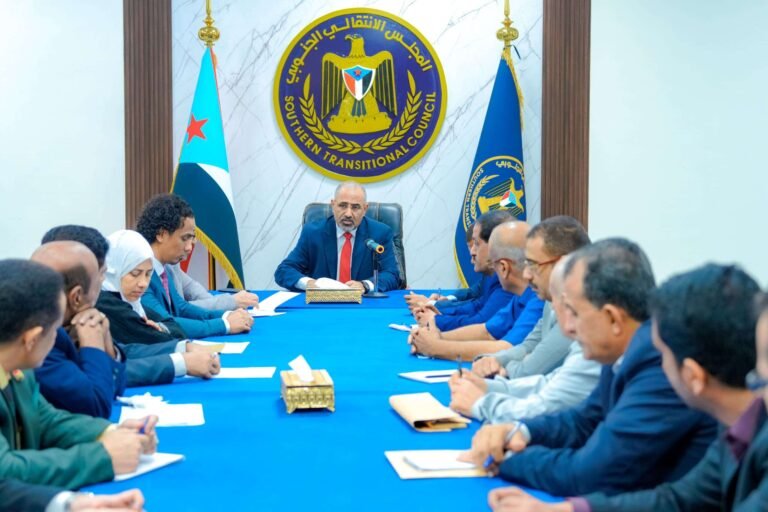
Aden, Yemen – The Southern Transitional Council (STC) issued a strongly worded political statement declaring a complete deadlock in the political process with the authorities in Aden. This came in the wake of coercive measures aimed at closing the headquarters of its senior bodies. The STC warned that these steps represent a systematic targeting of the political force representing the southern cause and a blatant attempt to exclude it from the political landscape.
Behind the scenes of the crisis and the authorities’ disavowal
The statement revealed that the council leadership had made responsible efforts from the very beginning of the crisis. It also conducted a series of communications with the local authority leadership, the government, and the leadership council in Ma’ashiq to ascertain the reasons for the closure of the headquarters. However, these efforts were met with a collective disclaimer of responsibility. All parties claimed they had not issued any orders for the closure. Furthermore, everyone placed the blame on Presidential Leadership Council member Abu Zur’ah al-Mahrami. The council described this situation as “chaos and a lack of responsibility.”
Call for peaceful assembly
Faced with this impasse, the Southern Transitional Council called on its members, supporters, and all citizens to participate in a peaceful mass rally in the capital, Aden, on Wednesday, April 1, 2026, in front of the General Assembly building in the Tawahi district. The Council affirmed that this action is a rejection of the policies of repression and intimidation, a demand for the unconditional reopening of its headquarters, and a reaffirmation of its commitment to the fundamental principles of the southern national cause.
Warnings against compromising military gains
The statement held the southern political and military leadership within the de facto authority fully responsible for the repercussions of this escalation. The council also expressed its deep concern over attempts to “dismantle the Southern Armed Forces” and transform their national doctrine into a tool for external conflicts. This came especially after the complete liberation of the national territory in January 2016. The council commended the patriotic stance of a number of officers and members of the headquarters guards who refused to suppress their fellow citizens. These individuals subsequently faced dismissal or suspension.
Final message: The will of the people cannot be broken.
The Southern Transitional Council concluded its statement by reaffirming its commitment to peaceful means, while simultaneously warning that suppressing political activity and closing offices would only lead to further public discontent. It emphasized that the will of the people of the South, which had thwarted previous attempts at repression, is now capable of protecting its gains and restoring its legitimate right to expression and political representation. It asserted that “the will of the people cannot be broken or ignored.”