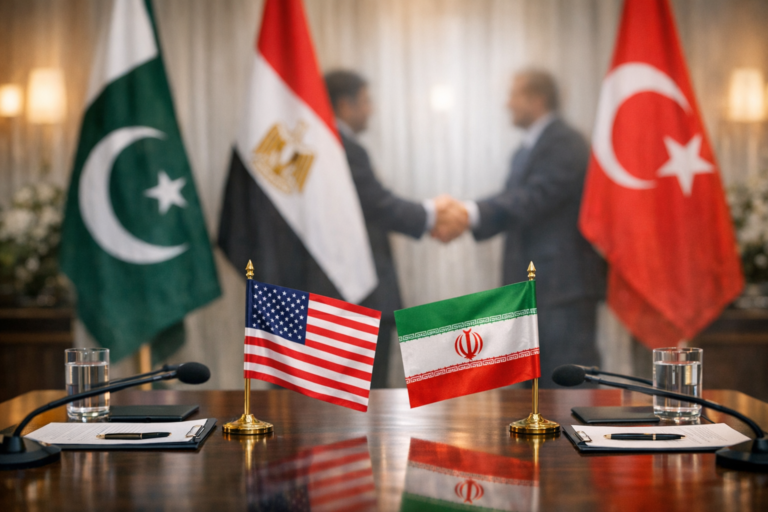
Dubai, UAE – As regional efforts intensify to contain the conflict between the United States and Iran, Islamabad has emerged as a hub for attempts to open an indirect negotiating channel. This follows a ministerial meeting that included Pakistan, Egypt, Turkey, and Saudi Arabia to discuss de-escalation. Political analysts suggest this move reflects not only a desire to mediate but also a genuine concern among these countries that the conflict could escalate further. Such an escalation would threaten the security of the Gulf, maritime navigation, energy supplies, and the global economy.
Islamabad is making progress towards de-escalation
Pakistan appears to be the most proactive party in this process, not only because it maintains channels of communication with both Washington and Tehran, but also because it has positioned itself as a suitable conduit for indirect messages between the two sides. This stance grants Islamabad a prominent political role. However, it simultaneously reveals the extent of the predicament it seeks to avoid should the war escalate.
Pakistan: A mediation shaped by geography and alliances
Pakistan shares a direct border with Iran and is heavily dependent on the stability of the Gulf and its maritime routes. Its defense relationship with Saudi Arabia makes any escalation of the conflict in the Gulf a highly sensitive development for it. Therefore, Pakistani mediation appears to be an attempt to avoid a slide that could place it under strategic pressure. It finds itself caught between its Gulf commitments and its complex relationship with Iran.
This equation makes Islamabad’s move more than just a traditional diplomatic effort; it is essentially a preemptive attempt to protect its security and political interests. It is also an attempt to prevent reaching a point where it is forced to choose between two important partners in a highly complex regional equation.
Egypt: Containing the escalation to protect security and the economy
Egypt, however, is operating from a different but no less urgent perspective. Cairo views any escalation of the war in the Gulf as a direct threat to regional stability. It also sees potential repercussions for maritime security, trade, and energy supplies, as well as broader economic consequences for the entire region.
From this perspective, Egypt appears eager to mediate not only as a diplomatic role, but also as a preventative necessity. The closer war gets to the Gulf, the higher the cost of tension will be for Arab economies and for trade and energy flows. Furthermore, the cost to regional security balances will increase. Therefore, Egypt’s move can be interpreted as an attempt to prevent a moment when Arab capitals are forced to make more difficult and costly choices—politically, economically, and in terms of security.
Turkey: Political support to prevent the escalation of the confrontation
For Turkey, its support for the Pakistani approach is based on calculations of both influence and strategic location. Ankara understands that the continuation or expansion of the war threatens the stability of its regional neighborhood. It also increases the likelihood of security and economic chaos in a region where its direct interests intersect with energy, trade, and security issues.
Turkey also possesses diplomatic leeway with multiple parties, enabling it to play a supportive role in keeping lines of dialogue open. It is also capable of preventing the conflict from spreading to additional arenas. Therefore, its involvement in this process appears to be part of a broader policy aimed at preventing a complete regional collapse.
Mediation of interests, not mediation of neutrality
Ultimately, Pakistan, Egypt, and Turkey are not acting simply because they are neutral in the traditional sense, but because they stand to lose the most from the consequences of failure. Pakistan fears that the war will become a direct test of its balance between Saudi Arabia and Iran. Egypt sees the security of the Gulf and the stability of energy markets as integral to its strategic and economic security. And Turkey views the war as a direct threat to the stability of its regional neighborhood.
Therefore, mediation here appears to be more of an expression of converging interests and a need for de-escalation than a mere protocolary initiative. These countries are not acting from the position of mere spectators, but rather from a position of understanding that the expansion of the war will impose upon everyone a price that will be difficult to bear later.
Will regional channels succeed in stopping the war?
However, the success of this approach hinges on shifting efforts from crisis management to initiating direct or indirect negotiations between Washington and Tehran. So far, indications suggest that regional meetings have succeeded in establishing communication channels and exchanging messages. But they have yet to produce a decisive political breakthrough. As the situation on the ground continues to escalate, the mediators’ ability to prevent further deterioration will depend on the willingness of both sides to give diplomacy a chance beyond simply buying time. Until that happens, regional mediation will remain a necessary attempt to contain the conflict, but it is not sufficient on its own to extinguish it.