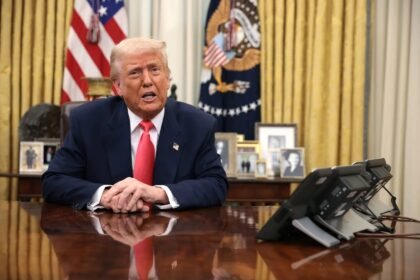
Washington, DC – In a politically charged move with complex diplomatic implications, US President Donald Trump announced that the United States would like to host a direct meeting between Vladimir Putin and Volodymyr Zelensky. This comes as an attempt to open a window for dialogue amid one of the world’s most intricate crises.
Trump explained that his country is ready to play a mediating role to bridge the gap between Moscow and Kyiv. He also indicated that “the time has come to sit down and negotiate,” alluding to the growing international pressure to end the years-long conflict.
This proposal comes against a backdrop of political and military stalemate. Previous efforts have failed to achieve a real breakthrough, making any new initiative, especially one sponsored by Washington, highly anticipated internationally.
Observers believe that Trump’s invitation reflects a desire to reposition the United States as an active player in the settlement process, especially as the war continues to drain all sides and its effects extend to the global economy and energy security.
However, the chances of success for such a meeting remain contingent on complex calculations. These chances are also linked to the divergent positions of Moscow and Kyiv regarding the terms of negotiation, which could make simply holding the meeting a challenge in itself.
Furthermore, any such move may face obstacles related to mutual trust and guarantees of implementation. In addition, each side faces internal pressures, complicating the chances of achieving tangible results quickly.
The overall picture reflects a new attempt to break the deadlock. However, between the invitation and reality lie thorny issues that make a “dialogue table” a difficult, albeit necessary, objective at a time when the international community is searching for a way out of an open-ended war with no clear end in sight.