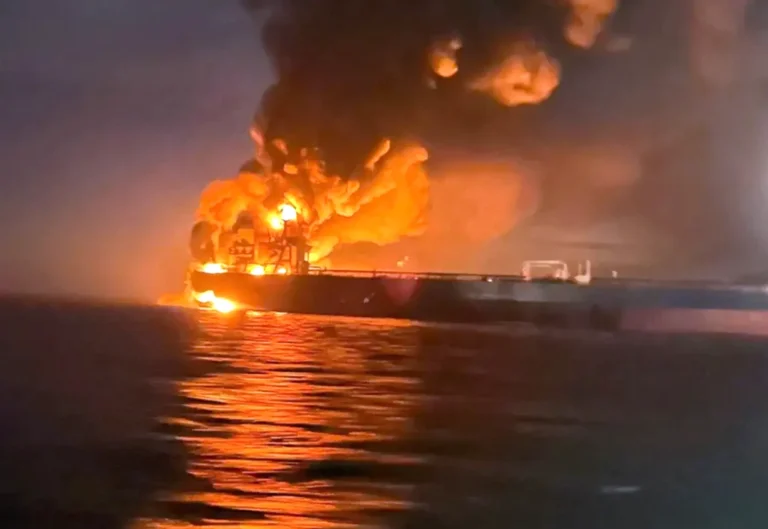
Athens, Greece – In a security development reflecting the spillover of regional tensions into vital waterways, Greek Shipping Minister Vassilis Kikilias announced on Saturday that a Greek-flagged oil tanker was attacked off the coast of the strategic Russian port of Novorossiysk in the Black Sea.
This incident comes at a sensitive time. It coincides with shifts in international policies regarding
the transport of Russian oil, posing new challenges to the security of commercial shipping.
Details of the attack and the crew’s situation
In statements to the Greek state broadcaster ERT, Kikilias explained that the attack occurred in the early hours
of Saturday morning off the coast of Novorossiysk, a major oil export hub in the region.
The minister confirmed that the tanker, chartered by the American oil giant Chevron, had a crew of 24, including 10 Greek nationals.
The minister reassured the crew’s families and the maritime community that all the sailors were “in good health” and that no injuries had been reported.
Initial reports also indicated no significant damage that could lead to an oil spill or the ship sinking. He added that Greek authorities were closely monitoring the situation in conjunction with international search and rescue organizations.
Geopolitical implications and linking paths
The Greek side directly links this attack to a series of recent regional decisions and tensions.
Minister Kikilias believes the attack “is possibly connected to recent international decisions allowing limited transit of Russian oil.”
This places commercial vessels in the crosshairs of political and economic conflicts.
These developments come just two days after US Treasury Secretary Scott Bisnett announced a decision
allowing countries to temporarily purchase Russian oil “stuck” on ships en route to their destinations before certain restrictions were imposed.
Bissent described the move as a “short-term, carefully targeted measure”
aimed at expanding current global supplies without significantly boosting Kremlin revenues.
However, the recent attack suggests that securing these shipments may face serious logistical challenges.
Greek diplomatic escalation
The Greek minister described the targeting of ships sailing under the Greek flag or with Greek crews
as “unacceptable and extremely dangerous,” emphasizing that his country would not stand idly by in the face of this threat.
Kikilias warned that Greece, which possesses one of the world’s largest merchant fleets,
would raise the issue at the European Council level if necessary.
The aim is to ensure the protection of international navigation and prevent merchant ships
from becoming legitimate targets in armed or political conflicts.
Concerns about energy market disruption
The attack off Novorossiysk is raising serious concerns among economic analysts,
as any disruption at this particular port could lead to a sudden surge in global oil prices.
Shipping and marine insurance companies are closely monitoring the situation,
anticipating a rise in insurance premiums for vessels operating in the Black Sea.
This could increase transportation costs and impact oil supplies at a time when the world is seeking stability in the energy market.
So far, Russian authorities have not issued an official statement clarifying the type of weapon used in the attack or identifying the party responsible.
Meanwhile, technical investigations are ongoing to determine the extent of the damage to the Greek tanker before it resumes its voyage.