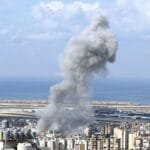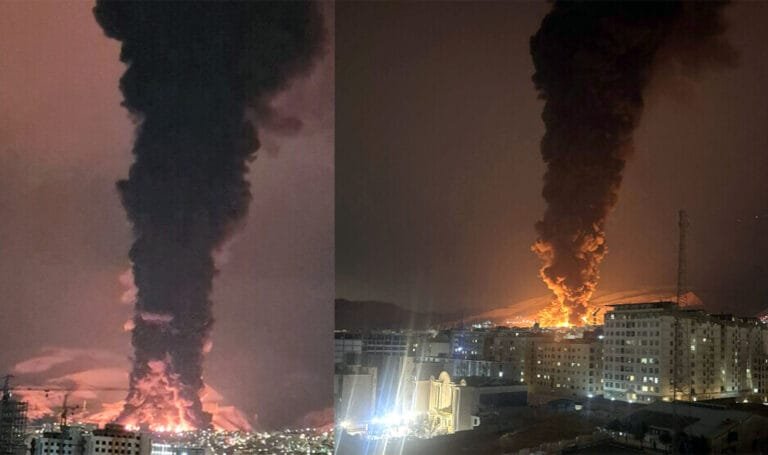
Tehran, Iran – Environmental and health concerns are escalating in the Iranian capital, Tehran. Fires continue to burn at vital fuel storage tanks targeted by Israeli strikes on the evening of March 6.
More than ten hours after the attack and into daylight, flames and thick smoke still blanket large swathes of the city’s sky.
This has prompted authorities to issue unprecedented warnings regarding the safety of residents and the environment.
Warnings of “chemical burns” and toxic rain
The Iranian Red Crescent Society issued an urgent statement warning of the potential
for highly dangerous acid rain resulting from a chemical reaction between the dense smoke and clouds.
The statement explained that the explosion at the oil storage facilities released enormous quantities
of toxic compounds, such as complex hydrocarbons, sulfur oxides, and nitrogen oxides.
The organization emphasized that if these substances mix with raindrops, they will create highly acidic water.
The Red Crescent strongly advised citizens to wash their skin with cold water immediately if they come into contact with the acid.
Furthermore, it advised against rubbing the affected area. It also recommended disposing of wet clothing in sealed bags.
Furthermore, it advised against rubbing the affected area and recommended disposing of wet clothing in sealed bags.
Environmental and social mobilization: Tehran is a “closed city”
For its part, the Environmental Protection Organization urged residents of the capital to avoid any unnecessary outdoor activities and remain indoors. It confirmed that pollution levels had far exceeded safe limits due to the intrusion of smoke into residential areas.
Videos documenting the extent of the damage and the black smoke clouds that blocked out sunlight in some neighborhoods circulated on social media. This led to widespread public concern about the infrastructure’s ability to cope with the situation.
The political and economic dimensions of accountability
This disaster deepens the crises facing Iran. Economically, the loss of strategic fuel reserves represents a severe blow to the domestic energy market. This could potentially lead to long queues and imminent transportation crises.
Politically, calls for accountability are growing regarding the preparedness of firefighters and civil defense teams to handle such major incidents under international sanctions and pressure.
Culturally and religiously, these crises are intertwining with people’s daily lives, disrupting some group activities and scheduled sporting events. Meanwhile, migrants and refugees in the surrounding areas are anxiously awaiting news of their fate under these difficult circumstances. Even within prisons, there are concerns that inmates will be affected by the pollution without adequate protection.
All eyes remain fixed on the heavens, awaiting the outcome of the firefighting efforts. Meanwhile, everyone is also wondering whether nature will unleash further toxins, exacerbating the suffering of the already exhausted residents of the capital.