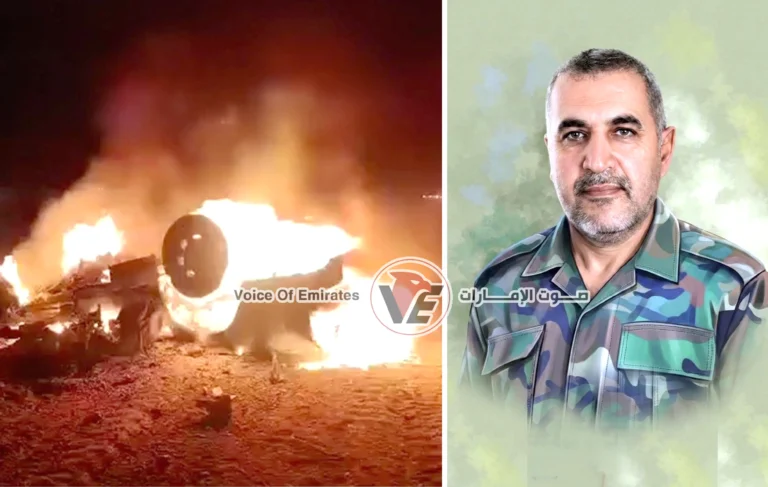
Baghdad, Iraq – The Iraqi Hezbollah Brigades, the most prominent faction under the banner of the “Islamic Resistance in Iraq” and supported by Iran, announced on Thursday the killing of one of its senior field commanders as a result of an air strike that targeted a vehicle belonging to the faction in the Jurf al-Nasr area south of the capital, Baghdad, in an incident that increases the level of security tension in the country, which is trying hard to distance itself from the explosive regional conflicts.
Official statement and details of the attack
In an official statement marked by a threatening tone, the Secretary-General of Kataib Hezbollah, Haj Abu Hussein al-Hamidawi, mourned “the great commander, Ali Hassan al-Fariji,” praising his strategic role in carrying out the group’s missions for more than two decades.
This announcement came hours after the ambiguity surrounding an attack on a civilian vehicle near the Jurf al-Nasr base (formerly known as Jurf al-Sakhr).
Field sources within the group told AFP that the death toll had risen to three, including the commander al-Fariji, after initial reports indicated only two fatalities.
A senior source within the group described the attack as a “joint Zionist-American strike” that precisely targeted a vehicle moving in the vicinity of the base, where Popular Mobilization Forces fighters are deployed.
The Jurf al-Nasr area is highly strategic and sensitive, having historically been the primary target of strikes attributed to the United States and Israel deep inside Iraq since the recent escalation in the Middle East. It is a closed military zone controlled by specific armed factions.
Baghdad airport targeted by drones
In a related development indicating the expansion of military operations, Baghdad witnessed a significant security escalation on Wednesday, with security sources announcing the downing of three suicide drones in the vicinity of Baghdad International Airport.
The airport houses a military base that includes a logistics support team from the US Embassy and has been a major hub for international coalition forces for many years.
This attack coincides with the announcement by the “Islamic Resistance in Iraq” of its intention to escalate operations against US bases in response to what it describes as “ongoing aggression” in the region.
Iraq: Between the Hammer of Stability and the Anvil of War
Observers believe these developments place the Iraqi government in a highly awkward position. While Baghdad is attempting to consolidate the relative stability the country has recently experienced, pro-Iranian factions are imposing a different reality on the ground.
Kataib Hezbollah and other groups have asserted that they “will not remain neutral” in the ongoing conflict between Iran and its allies on one side, and the United States and Israel on the other.
Statistics indicate that the exchange of airstrikes since the start of the current war has resulted in the deaths of at least 14 fighters from Iraqi factions, most of whom belong to Kataib Hezbollah.
This has prompted these factions to once again use Iraqi territory as a launchpad for drones and missiles targeting regional objectives and US bases.
Fears of retaliatory attacks
There are fears that the killing of commander Ali Hassan al-Fariji could trigger a new wave of retaliatory attacks against Western interests in Iraq.
Statements issued by faction leaders clearly indicate that “response is coming,” potentially dragging Iraq into the heart of a proxy war that Iraqi diplomacy has tried to avoid through a series of international meetings and security agreements with Washington and Tehran.
With Israeli and American authorities remaining silent regarding the latest strike, anticipation hangs heavy in the air in Baghdad, as the coming hours unfold and could alter the fragile security balance in the country.