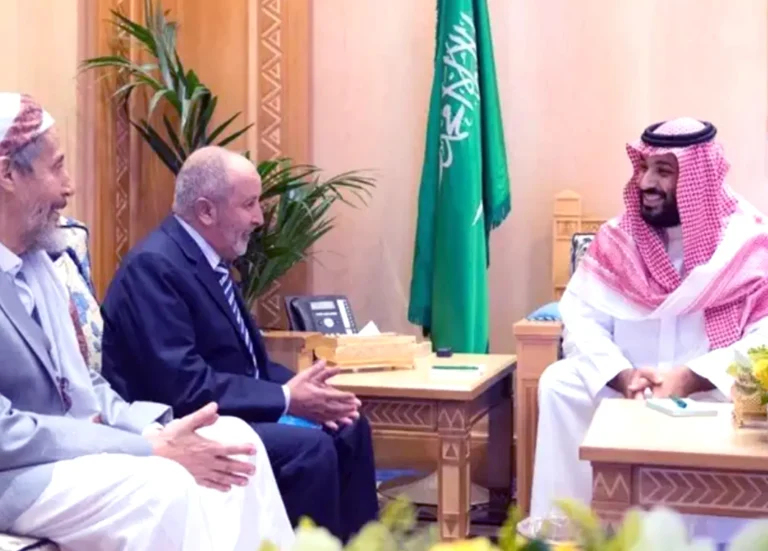
Aden, Yemen – In a radical shift that altered the balance of power in Yemen in 2026, Saudi Arabia moved from a policy of cautiously marginalizing the Yemeni Congregation for Reform (Islah Party, affiliated with the Muslim Brotherhood) to one of empowerment and strategic partnership.
This shift comes at a time of unprecedented tension between Riyadh and Abu Dhabi. It is manifested on the ground in airstrikes and changes in the alliances.
Messages in Fire
Saudi support for the Islah party is no longer limited to logistical support; it has escalated to direct protection.
In December 2025, Saudi warplanes launched airstrikes against forces loyal to the Southern Transitional Council. They justified the action as necessary to protect Saudi national security.
Also in December 2025, Riyadh launched airstrikes on the port of Mukalla, aiming to cut off foreign military support to the southern forces. Thus, they bolstered support for forces aligned with the legitimate government and the Islah party.
Furthermore, Saudi Arabia deployed the National Shield forces-comprised of Salafist and Muslim Brotherhood elements-through the Al-Wadi’ah border crossing.
These forces act as a counterweight to the southern forces in Hadramawt and Al-Mahra.
Riyadh is a haven for leaders
Riyadh has regained its role as a political power center for the Muslim Brotherhood’s reformist leaders,
hosting prominent figures such as Hamid al-Ahmar and Hamoud al-Mikhlafi in mid-January 2026.
Observers believe that the appointment of Mohsen al-Zindani as prime minister in the new government reflects
a Saudi desire to grant the Brotherhood faction broader powers.
This is happening despite international pressure and the Trump administration’s hardline stance toward the group.
Emergency alliances
The new empowerment strategy is raising widespread security concerns, especially with reports indicating that the Hadramawt National Council,
which includes tribal sheikhs and Islah party members such as Issam al-Kathiri and Badr Basalma,
is viewed as a Saudi tool to undermine the Southern Transitional Council.
Photos circulated by activists showing a meeting between Islah leaders and former al-Qaeda leaders
(such as Abu Omar al-Nahdi) in Seiyun have raised questions about the nature of the field alliances.
Riyadh is turning a blind eye to these alliances in order to confront its adversaries.
potential disaster
Saudi Arabia is betting that weakening the Southern Transitional Council and empowering the Islah-National Shield alliance will secure
its southern borders and preserve the legitimacy of the internationally recognized government.
However, analysts warn that Riyadh’s disregard for the will of the people in the south and its reliance on ideologically driven forces
that have proven ineffective in the past could lead the liberated provinces into a security catastrophe and widespread chaos.