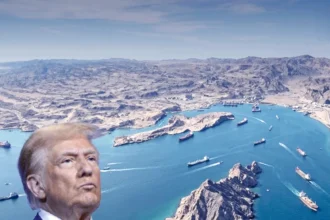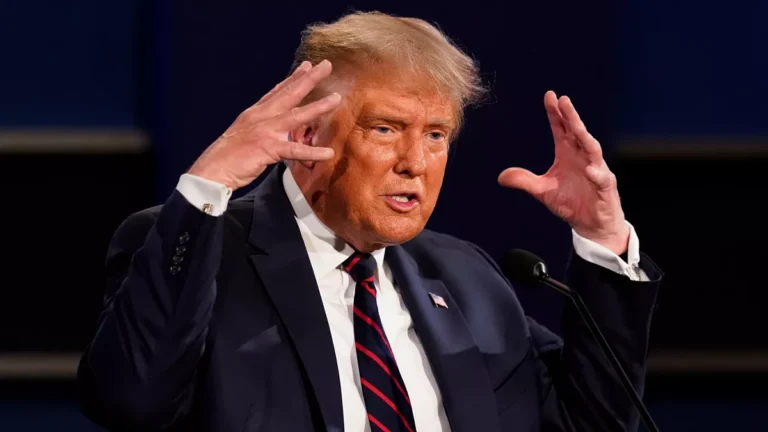
Washington, DC – In a speech that blended explicit military threats with calls for negotiations, US President Donald Trump unveiled a broad strategic plan targeting Iran. He confirmed the deployment of the largest and most powerful US warships to the region, placing them in close proximity to Iranian shores. This move followed the killing of Iranian protesters by their government. Speaking to reporters at the White House, Trump emphasized that the United States now possesses a massive military force deployed to the region, exceeding the size of any previously amassed in other conflicts, such as Venezuela.
Conversely, he stated that Washington is engaged in talks with Tehran, hoping to reach an agreement that would resolve the outstanding issues. He described the success of diplomacy as “a great thing,” while acknowledging that its failure could lead to “very bad things” that no one wants.
Diplomacy under the shadow of fleets and military movements
Trump’s statements coincide with an unprecedented military buildup in recent weeks, marked by the arrival of the aircraft carrier USS Abraham Lincoln and its strike group in the area of responsibility of the US Central Command. In addition, additional fighter jets and transport aircraft have been deployed to enhance combat readiness. This extensive deployment reflects Washington’s efforts to support the negotiating process from a position of strength, while maintaining the option of military deterrence. In this context, US Secretary of Defense Pete Haigset warned Tehran’s leaders that the Pentagon is more prepared than ever to take military action if Iran refuses to negotiate seriously regarding its nuclear program.
Haigset emphasized that President Trump has been clear since Operation Midnight Hammer that Iran’s acquisition of nuclear weapons is a red line that cannot be crossed. This leaves the Iranian regime with only two options: enter into genuine negotiations or face robust military options aimed at protecting US national security and Washington’s allies in the region. In response, Iranian President Masoud Pezeshkian announced his willingness to enter into “fair and equitable” negotiations with the United States, in a message published on the X platform. Pezeshkian said that, in response to requests from friendly governments in the region, he had instructed the Foreign Minister to provide the basis for negotiations based on the principles of dignity, wisdom and national interest, provided that a suitable climate free from threats and unreasonable expectations was available.
The anticipated Istanbul meeting and broad regional coordination
On the diplomatic front, political circles are anticipating a pivotal meeting next Friday in Istanbul, Turkey. The meeting will bring together President Trump’s special envoy, Steve Wittkopf, and Iranian Foreign Minister Abbas Araqchi to hear Iranian proposals and discuss the possibility of drafting a new nuclear agreement. The Washington Post, citing a regional official involved in the efforts to convene the Wittkopf-Araqchi meeting, reported that the foreign ministers of Turkey, Qatar, Egypt, Saudi Arabia, Oman, and Pakistan are scheduled to attend. This indicates a broadening of regional coordination.
The report also noted the participation of Jared Kushner, Trump’s son-in-law, in the high-level meeting between officials from the Islamic Republic and the United States. The report quoted the regional official as saying that the primary focus of the talks, if they take place, will be on the Iranian nuclear program. Following this, “innovative ways” to address non-nuclear U.S. demands will be explored. Meanwhile, the newspaper quoted a U.S. official as saying that finalizing the Istanbul meeting still requires “a lot of work.” These moves coincide with a planned visit by Litkov to Israel to meet with Prime Minister Benjamin Netanyahu, as part of coordinating positions with Israeli military leaders who recently visited Washington.
These shuttle diplomacy efforts aim to ensure alignment of views between Washington and its allies before entering into any formal commitments. This is especially important given Trump’s repeated invocation of the assassination of Qassem Soleimani as proof of his administration’s resolve in dealing with what he calls Iranian terrorism. He also asserts that Soleimani’s absence has weakened the regime’s ability to withstand pressure or protect its vital infrastructure.
Supporting protests and parliamentary pressure
In parallel, support is growing within the US Congress for a strategy that goes beyond the nuclear agreement to include supporting the Iranian people’s aspirations for change. Senator Lindsey Graham asserted that the Iranian regime is at its weakest point since 1979, given the escalating popular protests and the Iranian people’s readiness to demand a better life and reject repression. Graham noted that President Trump broke with the approach of previous administrations, which he described as having been deceived, and clearly sided with the protesters, thus bolstering the Iranians’ confidence in the possibility of receiving greater American support.
US lawmakers believe that the top priority should be ending what they describe as the era of terror imposed by the Iranian regime. Furthermore, they believe a secure environment must be provided for both Israel and the Iranian people. They also consider the current moment a historic opportunity to exert maximum pressure to achieve genuine change that will positively impact regional and international stability.