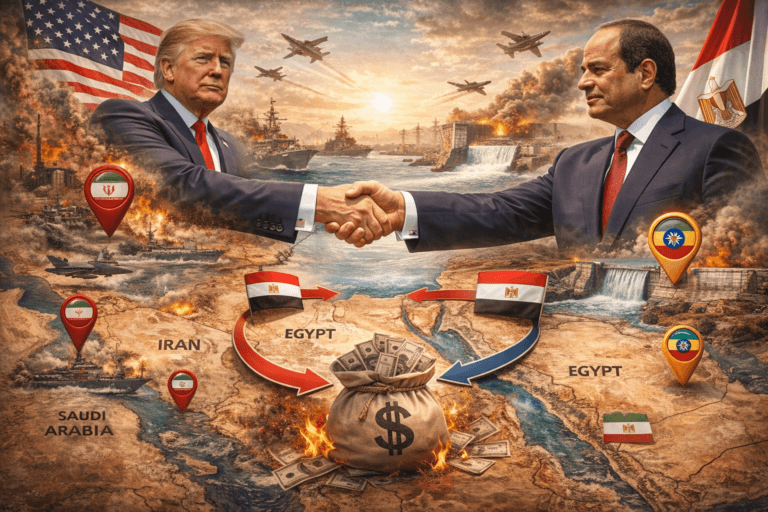
Cairo, Egypt – At a highly sensitive regional juncture, US President Donald Trump’s statement regarding the United States’ readiness to assist Egypt in negotiations with Ethiopia has raised questions about its political implications. This is particularly significant given its timing amidst escalating tensions between Washington and Tehran, and what is being described in the media as the “American war on Iran.” This convergence has prompted analysis into whether US support for Egypt in the Grand Ethiopian Renaissance Dam (GERD) issue is linked to Cairo’s role or position in the broader regional conflict.
Trump’s statement in its political context
Trump’s statements regarding Egypt and Ethiopia are consistent with a well-established pattern in his foreign policy, which focuses on: highlighting the United States’ role as a decisive mediator in international conflicts. It also involves leveraging sensitive issues concerning Washington’s allies to bolster political ties and appeal to the American public by projecting strength and international influence.
The Grand Ethiopian Renaissance Dam (GERD) issue is one of the most closely linked to Egyptian national security, and therefore any American signal of support for Cairo carries significant political weight. It is interpreted as a message of reassurance to a key regional ally.
Egypt and the US-Iranian conflict
Despite the escalating US rhetoric towards Iran, Egypt has for years adopted a cautious and balanced policy towards Tehran, based on: avoiding direct military confrontation, maintaining the security of vital maritime routes, especially the Red Sea and the Suez Canal, and supporting the stability of the Gulf without adopting an escalatory tone.
Thus, Egypt was not so much a party to the “war” as it was a stabilizing factor in a turbulent regional environment.
The point of convergence between the two files
The link between Trump’s support for Egypt in the Ethiopian issue and Cairo’s stance on Iran is not based on the logic of “direct quid pro quo,” but rather on the intersection of strategic interests:
1. Egypt as a reliable ally in a moment of tension
Washington, in times of escalation with Iran, needs: major partners who do not open new fronts and countries capable of setting the regional tone.
Egypt, with its balanced policies, represents this model, which makes supporting it in its vital issues a logical choice for the United States.
2. Political support instead of military involvement
Instead of demanding that Egypt play a direct military or security role against Iran, Washington preferred to: strengthen political coordination and provide diplomatic support on issues affecting Egyptian national security.
This explains the focus on the Grand Ethiopian Renaissance Dam (GERD) file as a top Egyptian priority.
3. Managing influence, not building solid alliances.
Modern American policy is not always based on rigid military alliances, but rather on: integrated networks of interests and regional roles.
In this context, Egypt is seen as a balancing force, not as a tool in the conflict with Iran.
Limits of the Egyptian role
It is important to emphasize that Egypt has not announced any military or logistical support for any American action against Iran. Furthermore, Cairo is keen to avoid exporting the conflict to its regional neighbors, and any rapprochement between the US and Egypt remains governed by the principle of prioritizing Egyptian national interests. Therefore, talk of an “Egyptian role in the American war on Iran” remains more of an exaggerated media characterization than a reflection of political reality.