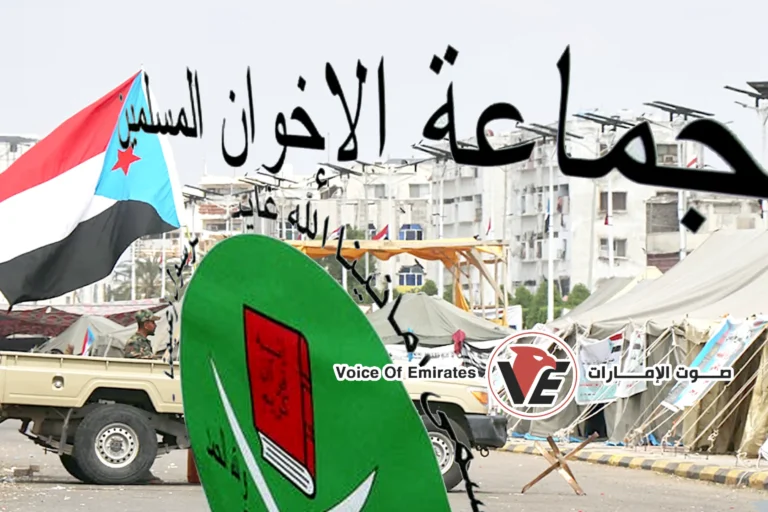
Aden, Yemen – The Muslim Brotherhood in Yemen poses a growing security and political threat, particularly amid the escalating conflict with the Southern Transitional Council (STC).
The STC controls large swathes of southern Yemen and is a key US partner in counterterrorism efforts.
This escalation comes as regional and international calls intensify for a reassessment of the role of the Islah Party,
the political arm of the Muslim Brotherhood in Yemen.
There are growing fears that it could be designated a terrorist organization,
similar to other branches of the group in other Arab countries.
The Muslim Brotherhood infiltrated Yemen
Observers believe that the Islah Party has managed to infiltrate Yemeni state institutions over the past few years.
They argue that the party exploited the war and political divisions.
This strategy has allowed it to expand its influence in strategic governorates such as Taiz and Marib.
Some Yemeni parties accuse it of having covert alliances with the Houthi group, despite its public rhetoric against them. This factor is considered an obstacle to the Arab coalition’s efforts against the Houthis.
A secret alliance between the Muslim Brotherhood and al-Qaeda
Yemeni experts describe the Islah Party as the most dangerous of the armed political forces.
This is due to its ability to change its organizational structure and shift between political activity and indirect support for extremist groups.
Local reports indicate the involvement of party members in supporting al-Qaeda and ISIS in the past.
In addition, there are accusations of obstructing humanitarian aid to southern regions, all in an effort to fuel conflicts and maintain its influence.
The danger of the Muslim Brotherhood to the South
In conjunction with previous US decisions to designate Muslim Brotherhood branches in the region as terrorist organizations, expectations are growing that this move could be extended to include Yemen.
This is especially likely after official demands from the Southern Transitional Council (STC),
which considers the Brotherhood an obstacle to building a responsible and stable government.
The STC believes that the continued influence of the Islah Party poses a direct threat to security in the south and undermines counterterrorism efforts.
In the south, tensions are escalating between the Islah Party and the STC.
The latter accuses the Brotherhood of waging media and incitement campaigns aimed at tarnishing its image
and linking it to the “chaos” in the Hadramawt and Al-Mahra governorates.
The STC asserts that since 2022 it has succeeded in reducing
the Brotherhood’s influence on the ground, particularly in Aden and other southern regions.
Consequently, according to its opponents,
this has prompted Islah to exploit the fragmentation of Yemen and attempt to
draw regional actors into a political confrontation with the STC.
Expected US move
Internationally, statements attributed to US Secretary of State Marco Rubio suggest that designating the Muslim Brotherhood as a terrorist organization may be a “first step.”
There is now a particular focus on the Yemeni arena due to what has been described as the organization’s infiltration and its role in enabling Houthi attacks on US interests in the Red Sea.
Analysts believe that protecting the south has become essential to prevent a “suspicious collusion” that could pave the way for the Houthis’ return.
They consider the Muslim Brotherhood an indirect partner in the breeding of terrorism.
Observers warn that the continuation of this conflict deepens regional divisions,
threatening the stability of southern Yemen and creating a conducive environment for the strengthening of extremist groups.
This occurs at a time when the country needs a more cohesive political and security path to end years of war and division.