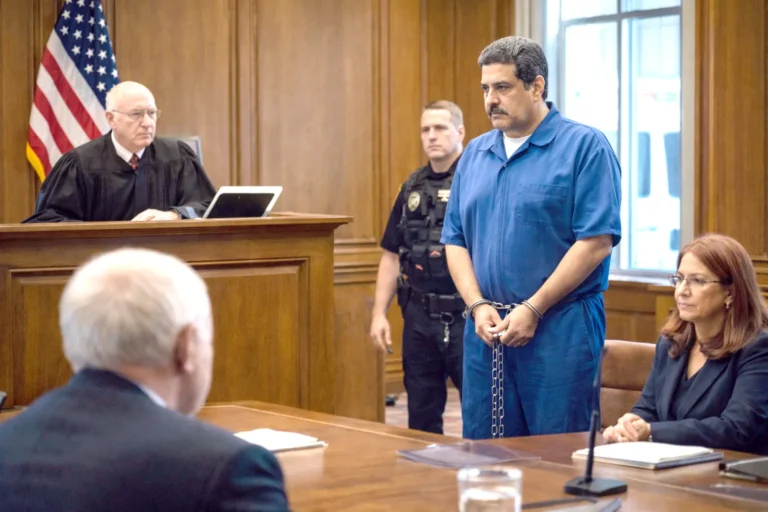
Washington, USA— Venezuelan President Nicolás Maduro appeared today before a U.S. court in New York. This development has sparked widespread political and legal controversy at both regional and international levels. During the hearing, he asserted that he remains the legitimate president of Venezuela, describing his situation as a “kidnapping from his home.”
According to international news agencies, Maduro told the judge that his transfer to the United States was forced and lacked any legal basis. He emphasized that what happened constitutes a “blatant violation of international law and the sovereignty of an independent state.”
He added, “I am the elected president of Venezuela, and what happened to me is a fully-fledged political kidnapping.”
Maduro’s statements came during an initial procedural hearing regarding charges brought against him by the U.S. prosecution.
These charges relate to drug trafficking, money laundering, and cooperation with criminal organizations. The Venezuelan government has consistently denied these allegations, calling them politically motivated.
During the hearing, Maduro asserted that he remains the legitimate president of Venezuela. He described what happened to him as a “kidnapping from his home.”
Sharp international division
Meanwhile, Maduro’s defense team asserted that the U.S. court has no legal jurisdiction to try him. They described the prosecution as a serious precedent in international relations.
They claimed it is an attempt to enforce a “politicized justice” approach. The defense called for his immediate release and the suspension of all judicial proceedings.
On the other hand, the U.S. prosecution emphasized that the cases against Maduro are based on investigations that have spanned several years. They argue that his appearance before the court represents “an opportunity to hold him accountable before justice.”
This hearing comes amid unprecedented political tensions between Washington and Caracas. These tensions are set against the backdrop of sharp international divisions over the legitimacy of U.S. actions.
Several parties have warned of serious repercussions from trying a sitting head of state in a U.S. court. This includes potential impacts on stability in Latin America and international relations more broadly.