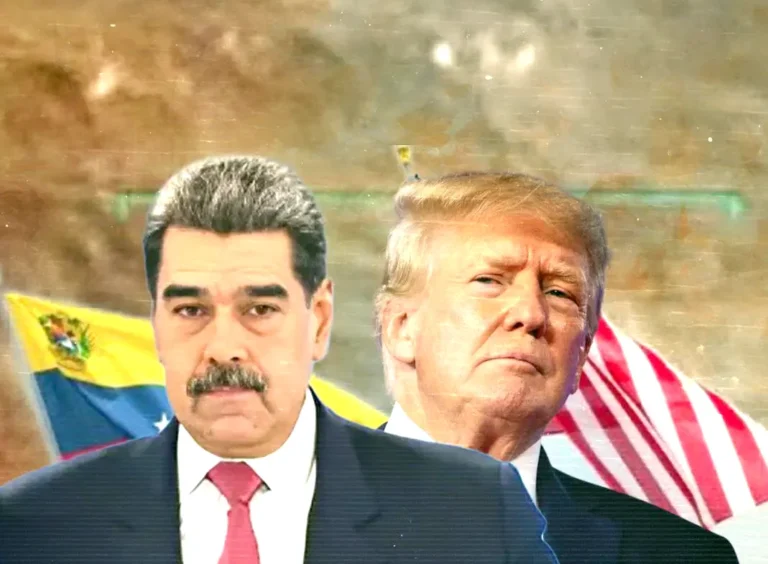
Washington, USA – With tensions escalating in Venezuela and President Donald Trump returning to the White House with a harsher tone towards the Nicolas Maduro regime,
US officials are discussing a scenario long considered a remote option:
a negotiated departure of the Venezuelan president to Türkiye.
That country, with whose leadership he has personal ties and economic interests
that have accumulated over a decade of political rapprochement.
According to informed officials who spoke to the Washington Post,
the idea of exiling Maduro to Türkiye is no longer confined to the realm of “theoretical possibilities.”
It has even become a topic of internal discussions involving national security circles
and the Ministry of Foreign Affairs.
This is in parallel with the United States strengthening
its military presence in the Caribbean.
An alliance forged by crises.. not just by interests
The relationship between Maduro and Turkish President Recep Tayyip Erdogan is neither new nor superficial.
Since 2016, when Maduro showed clear support for the Turkish government after the failed coup attempt,
Ankara has become one of Caracas’s most prominent political and economic partners.
In the following years, Türkiye helped Venezuela circumvent US sanctions through large-scale gold deals.
It reached approximately $900 million in 2018 alone, in addition to parallel financial and commercial channels that raised the volume of trade to more than $1.5 billion by 2023.
Maduro also visited Ankara repeatedly, and described Erdogan as a “brother”.
The latter was among the first to congratulate him after the July 2024 elections, which were rejected by more than fifty countries.
These ties, according to US and Turkish officials, make Türkiye the most realistic option.
This is if Maduro agrees to leave power in exchange for political and legal guarantees.
In Washington… there is a growing conviction that an “easy exit” might be less costly
With Trump insisting that “Maduro’s days are numbered,” the White House administration is considering several options,
including back-channel talks that were offered in September 2025.
It proposes forming a transitional government in which figures like Delcy Rodriguez
temporarily assume power, in exchange for safe passage for Maduro to Türkiye or Qatar;
Using military pressure by deploying naval and air forces in the Caribbean
under the guise of “counter-drug” operations.
This is despite doubts from lawmakers in both parties about the legal
and political feasibility of this move;
A broader economic deal may also include easing sanctions and resuming cooperation.
With the International Monetary Fund and the World Bank
to restructure the Venezuelan economy after Maduro’s departure.
According to sources who spoke to the newspaper,
Trump’s team is considering options that include providing “personal guarantees” to Maduro.
These include security protection and a comfortable exile,
in exchange for concessions related to oil, gold, and possibly the release of political prisoners.
Why Türkiye?
For Maduro, Türkiye represents a unique combination of political security
and diplomatic maneuvering ability.
Ankara is capable of providing “credible” guarantees
that he will not be handed over to the United States.
He faces charges including drug trafficking, corruption, and drug-related terrorism.
This is in addition to a US reward of $50 million for his capture.
Unlike Russia or Iran, Türkiye does not constitute an isolated
or highly controlled environment, nor does it weaken Maduro’s political standing.
As might happen in Moscow or Tehran.
While the deteriorating economic situation in Cuba makes it a less attractive option.
On the other hand, US officials believe that Ankara may aspire
to use the Maduro issue as a means to improve relations with Washington.
This includes restoring its position in the F-35 program and expanding
its role in the files between Russia, Ukraine and Gaza.
Concern in Caracas ..and a new reading of the scenarios
Despite the Venezuelan government’s repeated denials of any exit plan,
intelligence reports indicate that those close to Maduro are considering
a possible “landing point” outside the country.
Analysts believe that the inner circle around him is seeking
a way out that preserves its economic interests.
Its members prefer a less strict form of exile than that which Russia or Iran might impose.
Experts warn that more violent alternatives could leave a dangerous security vacuum.
Especially given the presence of groups like “Tren de Aragua” or “ELN”,
This makes the option of “controlled” exile attractive to Washington, Ankara, and Caracas.
A scenario that might satisfy everyone… or satisfy no one.
Officials who spoke to the newspaper believe that transferring Maduro
to Türkiye could be the “least costly way out” for all parties.
Trump will not be accused of allowing him to flee to a country hostile to Washington;
Maduro will get safe political exile without becoming a “shadow exile” in Moscow or Tehran;
Türkiye will gain a new bargaining chip that will strengthen
its role in regional and international politics.
But the picture remains unclear, the indicators are increasing,
the pressures are mounting, while the crucial question remains open:
Will Maduro choose a quiet exit via Ankara?
Or is the Venezuelan scene heading towards a more dangerous confrontation
than the country has witnessed in two decades?