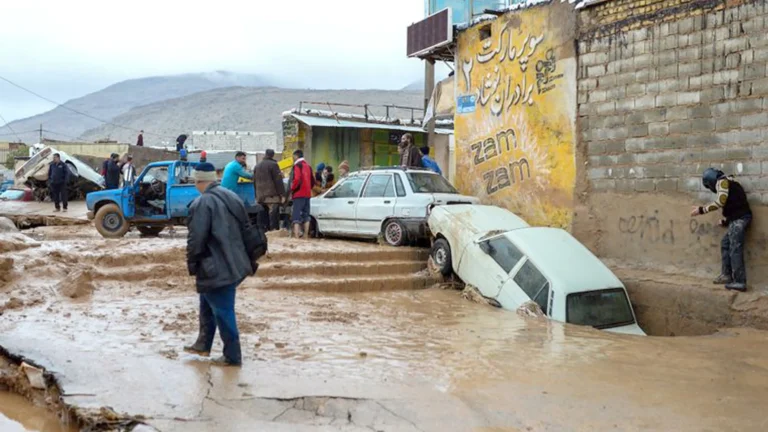
Tehran, Iran – The death toll from heavy rains and floods that swept through southern provinces of Iran has risen to seven, according to a statement released by the Iranian Red Crescent Society.
The toll included one aid worker, Mohammad Qurban, who lost his life
while performing his humanitarian duty in the city of Jahrom;
This added a tragic dimension to the ongoing rescue efforts.
Details of the victims
The human losses were spread across several regions; in Khuzestan province (Ahwaz),
the body of a 47-year-old man was recovered after eight days of searching.
Meanwhile, two young men were killed on the Lar-Jahrom road in Fars province.
Furthermore, the city of Jahrom recorded the death of a child
and a woman as a result of the flash floods.
Meanwhile, in Hormozgan province, the body of a 9-year-old girl was found
after she fell into a waterway in the village of Kiruyeh.
Large-scale relief efforts
In a related context, the Red Crescent Society revealed the scale of its field operations,
with more than 23,000 people receiving relief services in 24 Iranian provinces.
Accordingly, emergency housing was provided for more than two thousand people,
in addition to the evacuation of hundreds of damaged housing units.
And removing vehicles stuck on roads blocked by snow and floods.
This reflects the scale of the natural disaster that is hitting the region.
warnings to citizens
However, the crisis is not over yet; authorities have declared a state of maximum
alert for rescue forces due to the continued unstable weather conditions.
Therefore, the association called on citizens to avoid unnecessary travel,
especially in areas classified as high risk.
This is to avoid further casualties, given the expectation that the floods will continue.
Summary of the field scene
In conclusion, relief teams are still in a race against time to reach
isolated areas and secure the needs of those affected.
Since the infrastructure in some villages has been severely damaged,
The operations are currently focused on opening roads and providing food supplies.
This will ensure that the living conditions of the population stabilize as soon as possible.