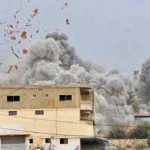
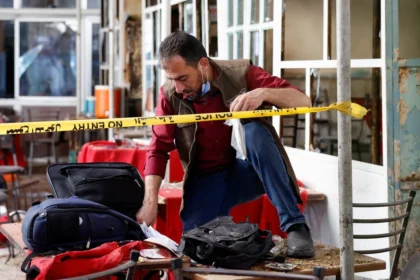
Washington, DC – US President Donald Trump announced that US forces, in close cooperation with the Nigerian Armed Forces, eliminated a senior leader of the ISIS terrorist organization. This was accomplished during a targeted military operation conducted on Friday.
The announcement came late Friday evening, Eastern Time. Trump posted on his Truth Social account, stating: “Tonight, at my direct direction, our brave US and Nigerian Armed Forces troops executed a meticulously planned and highly complex mission that successfully neutralized the world’s most active terrorist and removed him from the battlefield.”
The US president revealed the full identity of the targeted leader, stating that his name is Abu Bilal al-Manouki. He also explained that he holds the position of second-in-command of ISIS globally.
Trump added, emphasizing that this leader “will no longer terrorize the people of Africa or help plan terrorist attacks targeting American citizens and interests.”
US strategy to protect civilians
This deadly strike is not the first of its kind ordered by President Trump against ISIS militants in Nigeria. He has previously accused the group of persecuting and targeting Christians in the West African nation. Last December, Trump announced that he had ordered a “powerful and lethal strike against ISIS” in northwestern Nigeria. He also stated at the time that the group was carrying out systematic killings of innocent Christians.
These developments on the ground come at a time when the African continent is witnessing a significant and alarming expansion in terrorist operations over the past few months, according to specialized reports issued by the African Defense Forum. ISIS is particularly active in West Africa, specifically within what is known as the “Timbuktu Triangle” in Nigeria. This region, located in the northeast of the country, is where the organization is striving to establish its complete control in preparation for setting up its so-called “caliphate.” This triangle stretches across a vast geographical area of approximately 11,000 square kilometers, extending from Maiduguri in the east, through Dankalo in the north, and reaching as far west as Damboa. The dense undergrowth and vegetation of this area provide fertile ground for concealment, as these conditions provide cover for the organization’s military bases.
Escalating terrorist violence in the region
The group has recently witnessed a bloody escalation in attacks. On April 9, ISIS fighters, in collaboration with Boko Haram, launched coordinated attacks on a military base in the Bani Sheikh area of Borno State, Nigeria, and two neighboring villages. This resulted in the death of an army brigadier general and several soldiers.
On April 26, ISIS militants stormed a football field in the town of Guyako in neighboring Adamawa State. This attack killed approximately 30 people before they proceeded to burn down houses and a local church.
The figures reflect the scale of the tragedy; Nigeria recorded the largest increase in terrorism victims globally in 2025, with a 46% rise. The death toll jumped from 513 to 750, according to the Armed Conflict Location & Event Database (ACLED).
This security chaos is not confined to Nigeria alone. In neighboring Democratic Republic of Congo, Human Rights Watch reports document atrocities committed by the M23 rebels in eastern cities.
April also saw a violent attack by ISIS-affiliated militants on the Muchacha gold mine, one of the country’s largest. The attack resulted in the deaths of Congolese soldiers and 17 civilians, and the abduction of more than 100 others.