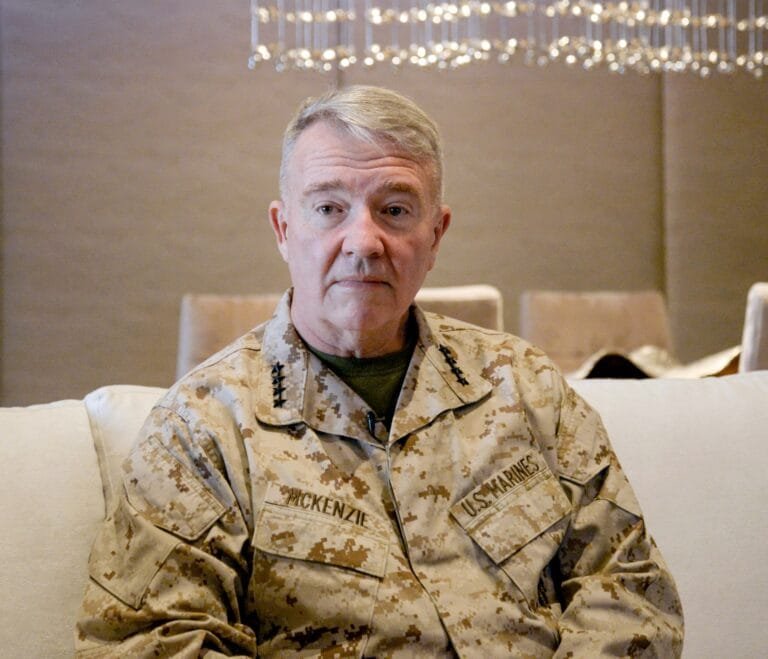
Washington – In a strategic interview outlining the next phase of the conflict, General Kenneth “Frank” McKenzie Jr., former head of U.S. Central Command (CENTCOM), stated that Iran, under a “hardline committee” led by the Islamic Revolutionary Guard Corps, will ultimately yield to existential pressure, likely making harsh concessions to avoid regime collapse or devastating economic attacks.
Crisis Management and Nuclear Alternatives
Kenneth “Frank” McKenzie Jr., who previously oversaw the integration of Israeli air defenses with regional allies, believes the primary objective of Washington and Jerusalem is to neutralize Iran’s threat capabilities, even without a fundamental regime change. He stated that Iran “will respond to existential pressure as it has in the past,” referencing the concept of the “poisoned chalice” (reluctant concessions).
He added that even if a formal agreement fails, turning Iran into an entity incapable of pursuing nuclear weapons or ballistic missiles would constitute a strategic victory, stating clearly: “If you build nuclear or missile threats, we will strike.”
Ballistic Missile Threat
General Kenneth “Frank” McKenzie Jr. argued that ballistic missiles currently pose a greater threat than the nuclear issue, suggesting informal constraints on rebuilding Iranian arsenals.
He revealed that Tehran’s reliance on underground facilities was a “major strategic mistake,” enabling the United States and Israel to monitor and target launch platforms once exposed, effectively rendering them “out of play.”
Regarding the erosion of Iranian capabilities, he questioned the slowdown in missile launches despite claims of large stockpiles, suggesting difficulties in replenishment and superior U.S.-Israeli surveillance capabilities.
Strait of Hormuz and Kharg Island: Power Options
On maritime security, Kenneth “Frank” McKenzie Jr. stressed the need to keep the Strait of Hormuz open, proposing a military option of “seizing Kharg Island” to disrupt Iranian oil exports, calling it a “severe humiliation” that could force negotiations without long-term economic damage.
He explained that controlling strategic islands does not necessarily require permanent occupation, but could be achieved through temporary raids or “precision aerial monitoring operations” to eliminate any Iranian presence threatening the waterway, alongside electromagnetic jamming to neutralize drones.
Military Campaign Assessment
Kenneth “Frank” McKenzie Jr. praised ongoing military operations, which peaked with Israeli Army announcing the destruction of all vital targets in Iran by late March 2026. He described the war as a “clash of human wills,” noting that frustration on the Iranian side now exceeds fatigue on the American and Israeli sides due to effective and sustained military pressure.
He concluded by warning about Iranian long-range missile programs, noting that attempts to target Diego Garcia reflect ambitions that require close monitoring, even if they have not yet reached the lethal maturity claimed by Tehran’s media.