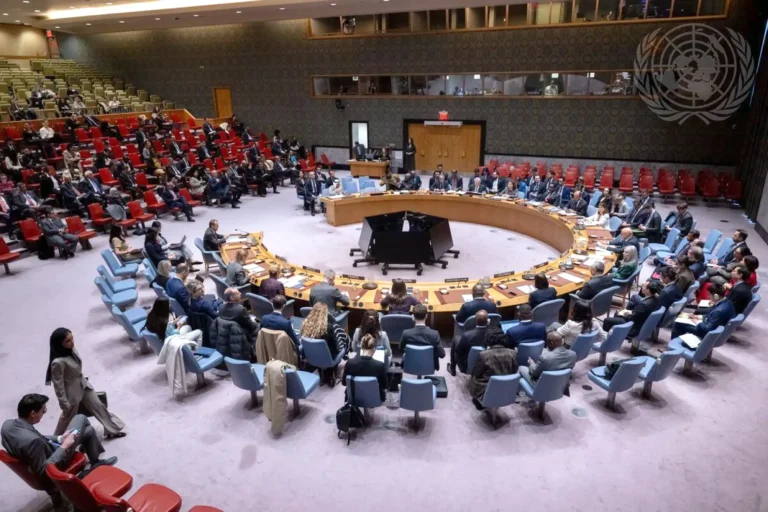
New York, USA – The UN Security Council failed on Tuesday to adopt a draft resolution submitted by the Kingdom of Bahrain demanding that Iran immediately cease all attacks on commercial vessels and refrain from any attempts to obstruct freedom of navigation in the Strait of Hormuz.
The draft resolution also called for allowing states to coordinate their defense efforts
to ensure the safety of ships and to provide escorts when necessary.
Voting details and veto right
Eleven countries voted in favor of the draft resolution, while Russia and China vetoed it, and Pakistan and Colombia abstained.
Bahraini Foreign Minister Abdullatif Al-Zayani, president of the Security Council for April,
expressed his deep regret at the Council’s failure to adopt the resolution.
He affirmed that Iran’s behavior constitutes a continuing challenge to international navigation
and stressed that this behavior warrants a firm international stance.
The Strait of Hormuz is an international responsibility
Minister Al-Zayani clarified that Iran’s threat to international navigation is not an isolated incident, but rather a recurring pattern.
He emphasized that Tehran has no right to close the Strait of Hormuz
and deprive the world of energy resources.
He affirmed that the Gulf states are a primary source of energy flow to the world,
thus making the Strait of Hormuz a shared international responsibility.
He called on the international community to take immediate action to protect freedom of navigation.
International security commitments and monitoring
The draft resolution condemns attacks and threats targeting commercial vessels and holds Iran responsible
for undermining maritime security and threatening global trade and energy security.
It also emphasizes states’ commitment to territorial sovereignty and the right of passage for ships
and aircraft under international law, as well as the right to defend vessels against attacks.
Furthermore, it calls on Iran to cease all attacks on civilian infrastructure, including oil and gas facilities and water treatment plants.
The resolution warns of the potential for these threats to spread to the Bab el-Mandeb Strait
and underscores the importance of international coordination to ensure global maritime security.