Paris, France – The election of Basi Konate as mayor of Sarcelles, one of the most prominent cities in the Île-de-France region, has sparked political and social debate in France.
Many consider it a dangerous sign of profound shifts in French society, contrary to the prevailing narrative of
a decline in the influence of political Islam in the country, particularly in multicultural cities.
New alliances that transcend traditional frameworks
The French newspaper Le Figaro published a report on the implications of Konaté’s rise, supported by the La France Insoumise party.
It indicated that this was not simply a typical electoral result, but rather reflected the formation of unconventional alliances
between radical left-wing movements and certain networks linked to political Islam, most notably the Muslim Brotherhood.
This outcome points to the existence of deep-rooted alliances based on a popular electoral base in working-class neighborhoods,
where identity and affiliation play an increasingly significant role in shaping voting behavior, often at the expense of traditional political programs.
The impact of the international context on domestic policy
The report also linked this shift to the international context, particularly the repercussions of the 2023 Gaza War,
which contributed to political mobilization within certain circles.
It was used as a rhetorical tool by political forces seeking to gain the support of specific segments of the electorate.
In this context, the discourse of some left-wing forces,
including Jean-Luc Mélenchon’s movement, is seen as more aligned with minority issues.
This strengthens their presence in areas like Sarcelles.
Social tensions and fears of division
The report also highlighted the fragility of coexistence in Sarcelles, a city historically known for its religious
and cultural diversity, home to Jewish, Muslim, and Christian communities.
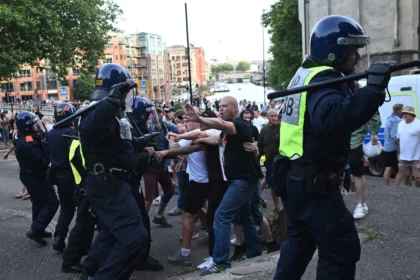
However, past events, such as the 2014 riots, have profoundly impacted relations between these diverse groups.
There are growing concerns that the rise of identity politics could lead to further social isolation.
This comes amid signs of declining interaction between communities and heightened sensitivity to religious and political issues.
Ultimately, the Sarcelles experience raises broader questions about the future of the republican model in France.
It also raises the question of whether this city represents an exception
or a microcosm of transformations that could extend to other French cities.
This is all happening against a backdrop of rapid demographic and political changes.