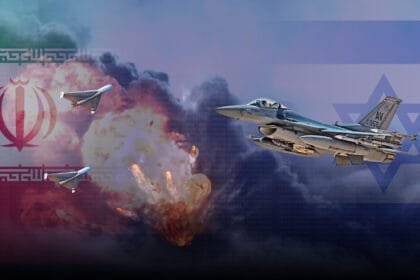
Tehran, Iran – In its most intense military escalation to date, the Israeli military announced on Sunday afternoon, March 15, 2026, a massive and widespread wave of airstrikes.
These attacks targeted government and military infrastructure in western Iran and its strategic heartland.
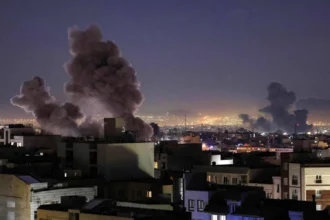
This official announcement capped a night and dawn of successive explosions that rocked major Iranian cities, leaving widespread panic and confusion.
Hamadan in the eye of the storm
Hamadan province (western Iran) was the initial epicenter of the escalation, with Iranian media reporting massive explosions that shook the city and surrounding villages.
Local sources from the villages of Sangestan and Absheneh reported at least four explosions, described as “seismic.”
The force of the blasts caused the ground and buildings to shake violently.
According to residents, the targets were not limited to publicly announced facilities but also included controversial sites. Eyewitnesses reported that a school on Golchehra Street, allegedly housing military personnel and ammunition, was targeted.
The list of strategic targets in Hamadan included the Abu Zar military garrison and the headquarters of the Red Light Zone Corps. The vital Seyyed al-Shohada garrison, located near the Ekbatan Dam, was also among the targets.
Tehran under bombardment
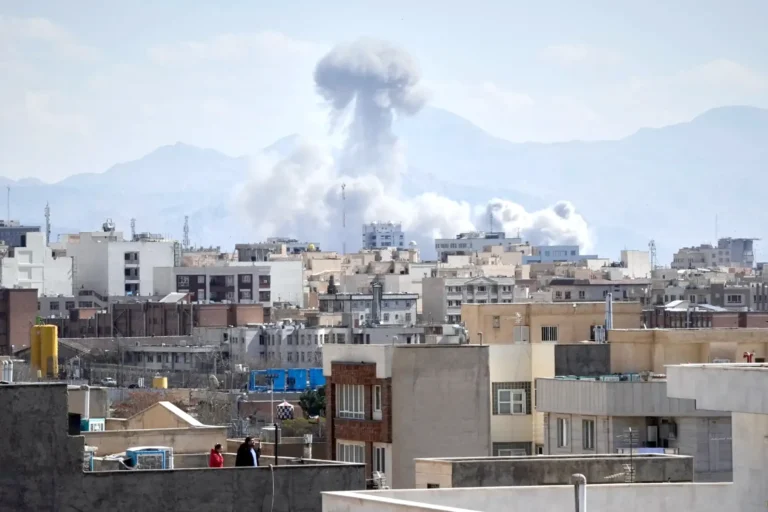
The capital, Tehran, was not spared from these attacks; Iranian media confirmed hearing loud explosions in various areas.
Citizens shared photos and videos on social media documenting moments of terror
and the shaking of buildings in the districts of Shahr-e Rey, Naziabad, Moniriyeh, Marzdaran, and Narmak.
This coincided with power outages in several areas. Reports also documented simultaneous explosions in Isfahan,
Sanandaj, Kish, Karaj, and Varamin. The explosions even reached the Nayband Naval District 4.
A close alliance and Lebanese conditions
Commenting on the operations, Israeli Foreign Minister Gideon Sa’ar affirmed that his country stands firmly with the United States in continuing the war against Iran until all objectives are achieved. He also denied any shortage in Israel’s missile defense systems.
On the Lebanese front, Sa’ar delivered a firm message, demanding that the Lebanese government take serious steps to prevent Hezbollah from launching rockets.
He emphasized that Israel has no plans to hold direct talks with the Lebanese government in the coming days, thus closing the door on any imminent diplomatic speculation.