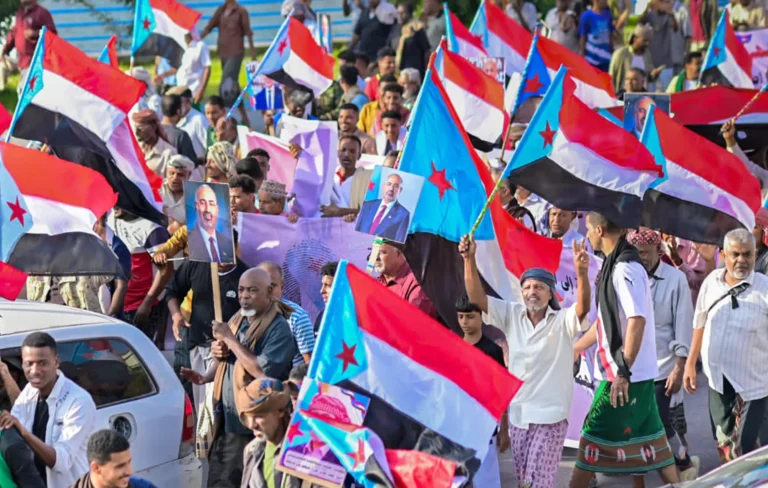
Shabwa, Yemen – In a scene reflecting the popular and tribal unrest gripping Shabwa Governorate, tribes from across its various districts convened for a massive tribal gathering in the city of Ataq.
These tribes declared their complete alignment and absolute solidarity with Sheikh Lahmar Ali bin Lasoud, head of the Southern Transitional Council’s executive body in the governorate.
This came in rejection of the “coercive order” issued against him by the Yemeni government’s Minister of Interior, Major General Ibrahim Haidan.
Tribal crowds and fleeting solidarity
The meeting was not limited to tribal sheikhs, dignitaries, and notables from Shabwa;
It also saw the notable participation of a high-level delegation from the Bakazim tribes of the neighboring Abyan governorate’s Mahfad district. As a result, this indicates the growing tribal solidarity with Bin Lasoud.
Those present affirmed that any attack on the head of the Shabwa Transitional Council is “
an attack on the dignity of all the tribes in the governorate” and an unacceptable transgression.
A “knife-headed” decision and a violation of the law
The tribal meeting issued a strongly worded concluding statement. It described the Interior Minister’s decision as “malicious and a blatant violation of the law and the authority of the local government.”
The statement noted that the minister preempted the findings of the investigation
committee formed by the governor of Shabwa, Awad bin al-Wazir, to examine the bloody events of February 11.
The official committee’s findings have not yet been released.
The statement demanded that the Interior Minister immediately withdraw the arrest warrant.
It also warned that persisting with this approach threatens to tear apart social cohesion. Furthermore, it could plunge the province into a dark tunnel of internecine conflicts.
The events of February 11th: The roots of the crisis
The background to this escalation lies in the bloody events that took place in the city of Ataq on February 11th.
Citizens had gathered to commemorate “Southern Martyrs’ Day” and renew their allegiance to the Southern Transitional Council, led by Aidarus al-Zubaidi.
Military forces responded with attempts at suppression and direct gunfire, resulting in five deaths and several injuries.
The Minister of the Interior, Sheikh Bin Lasoud, was accused of leading “incitement” to attack civilian institutions during those events.
The Minister of the Interior, Sheikh Bin Lasoud, was accused of leading “incitement” to attack civilian institutions during those events.
and cover up for those truly responsible for the bloodshed of the peaceful demonstrators.
General mobilization and the path of escalation
At the conclusion of their meeting, tribal leaders in Shabwa emphasized the necessity for the local investigation committee to operate with complete impartiality. This is needed in order to hold the true perpetrators accountable.
They reaffirmed their confidence in Governor Awad bin al-Wazir and his efforts to establish security.
And they also announced a state of “continuous consultation and mobilization” among the tribes.
They stressed that any attempt to implement the arrest warrant would be met with a “unified and immediate tribal response.”
Observers believe this mobilization presents the Yemeni government with a difficult choice:
either to retract the decision and contain the situation diplomatically,
or to proceed with measures that could ignite an armed confrontation
between the Ministry’s forces and the powerful tribal bloc in the oil-rich province.