Exclusive, Voice of the Emirates – Following the outbreak of violent attacks launched by the United States and Israel against Iran in early March 2016, the Iranian arena entered a phase of “political and security fluidity.” This came especially after the shocking news of the assassination of Supreme Leader Ali Khamenei and a number of senior officials. With the collapse of traditional leadership centers, attention began to turn towards the country’s “western front.” There, the issue of the Iranian Kurds returned to the forefront, not only as an ethnic minority, but also as a “balancing force” in the escalating regional conflict.
- The Kurds in Iran: Geography and Identity
- Armed Forces Map: Armies in Waiting
- Iranian Kurdistan Democratic Party
- Komala Party
- Kurdistan Freedom Party
- Kurdistan Free Life Party
- The American plan: “The spearhead”
- Reactions: Scorched Earth
- Complex obstacles: Geography is unforgiving
- A people caught between a rock and a hard place
The Kurds in Iran: Geography and Identity
The Kurds are the third largest ethnic group in Iran, numbering around 12 million. Their presence is concentrated in a strategic mountainous region bordering Iraq and Turkey, and they are distributed across the provinces of Kurdistan, Kermanshah, West Azerbaijan, and Lorestan.
The city of Mahabad is considered their “spiritual compass,” as it was there that the first Kurdish republic was declared in 1946. Despite its swift collapse, it left an indelible legacy of the desire for autonomy. Linguistically, they speak Sorani and Kalhori, and religiously, most belong to the Shafi’i branch of Sunni Islam. This has created a deep identity divide with the officially Shi’a system of “Guardianship of the Islamic Jurist” (Velayat-e Faqih), a divide exacerbated by decades of cultural and economic marginalization.
Armed Forces Map: Armies in Waiting
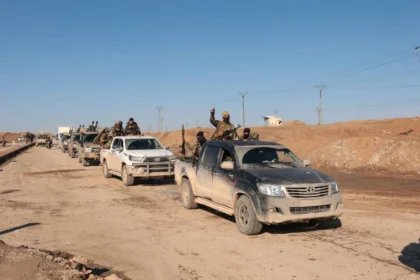
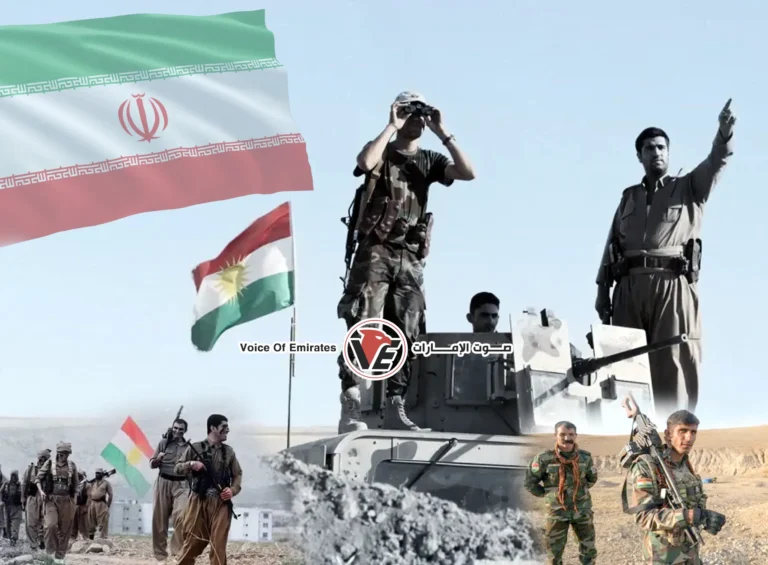
Several Iranian Kurdish factions are entrenched in the mountains of Iraqi Kurdistan, and they possess thousands of fighters who regrouped following the outbreak of the 2026 war. These are the most prominent Kurdish armed forces:
Iranian Kurdistan Democratic Party
The Kurdistan Democratic Party of Iran (KDPI) is one of the oldest Iranian Kurdish parties, having been founded in 1945. It played a key role in the Mahabad Republic experiment and is currently led by Kurdish politician Mustafa Hijri.
The party’s fighters, known as Peshmerga, are deployed at bases near the city of Koya in Iraq’s Erbil Governorate. The party’s political platform advocates for greater Kurdish autonomy within Iran under a democratic system.
Komala Party
The Komala Party – the Organization of Revolutionary Kurds of Iran – was founded in 1969. Initially Marxist-Leninist in orientation, it later splintered into several factions. Today, it is one of the most prominent Kurdish armed groups, having engaged in frequent clashes with the Iranian Revolutionary Guard Corps.
Despite its organizational divisions, the party maintains a military presence in the mountainous border regions.
Kurdistan Freedom Party
The Kurdistan Freedom Party (PAK) also stands out as one of the most active factions on the ground. In January 2025, it claimed responsibility for attacks targeting members of the Iranian Revolutionary Guard, in retaliation for the crackdown on Kurdish protesters.
Kurdistan Free Life Party
Another influential organization is the Kurdistan Free Life Party, known as PJAK, which is considered the Iranian branch of the Kurdistan Workers’ Party (PKK), ideologically and organizationally linked to the PKK, whose leader is imprisoned in Turkey, Abdullah Öcalan.
The party advocates for a “democratic confederalism” project, calling for a decentralized political system.
However, the designation of PJAK as a terrorist organization by the United States and the European Union complicates the prospects for direct cooperation between it and Washington.
The American plan: “The spearhead”
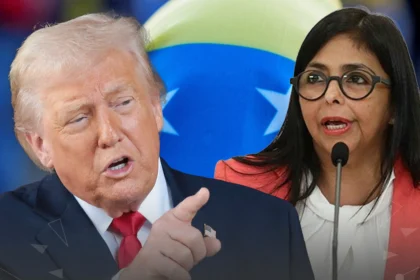
CNN leaks have revealed a dramatic shift in CIA strategy, moving from surveillance to active arming. The Trump administration aims to transform these factions from defensive forces into a spearhead for penetrating deep into Iran.
According to reports, the US strategy relies on the principle of “attrition from within.” While Israeli and US airstrikes cripple Iran’s air defenses, advanced weaponry, including anti-tank missiles and suicide drones, flows to Kurdish factions across the mountainous border.
The goal is to force the remaining Iranian security forces to engage on a broad internal front. This, in turn, paves the way for a major popular uprising in Tehran and other major cities.
Reactions: Scorched Earth
Tehran was quick to respond; the Revolutionary Guard launched fierce retaliatory strikes with ballistic missiles and drones against the headquarters of these parties in Erbil and Sulaimaniyah.
These strikes not only targeted fighters but also resulted in civilian casualties and caused panic in Erbil’s residential neighborhoods. This placed the Kurdistan Regional Government in the crosshairs of its powerful neighbors and the ambitions of its opposition allies.
Complex obstacles: Geography is unforgiving
Despite these developments, the use of the Kurdish card faces several obstacles. Iraqi National Security Advisor Qasim al-Araji affirmed that Iraq will not allow its territory to be used as a launching pad for attacks against Iran, highlighting the sensitive position of the Kurdistan Region within the regional equation.
Intelligence assessments also indicate that Iranian Kurdish groups currently lack the military or popular support necessary to launch a widespread uprising without significant external backing.
Additionally, there are concerns that arming Kurdish factions could ignite separatist movements in other parts of Iran, such as the Baloch-inhabited regions. This could potentially draw neighboring countries like Pakistan into the conflict.
Furthermore, Turkey is highly sensitive to any Kurdish armed activity near its borders, given its complex relationship with the Kurdistan Workers’ Party (PKK).
A people caught between a rock and a hard place
In March 2026, Iranian Kurds found themselves caught between the hammer of nationalist aspirations and the anvil of international calculations. While some saw this war as a “historic moment” to reclaim rights lost since 1946, others feared a repeat of past historical “abandonment” by Washington.
The question echoing today in Mahabad and Sanandaj is: Will the Kurds be partners in shaping the map of a “new Iran,” or will they remain merely a bargaining chip used in war and discarded at the negotiating table? History is watching, and only the mountains know the secret.