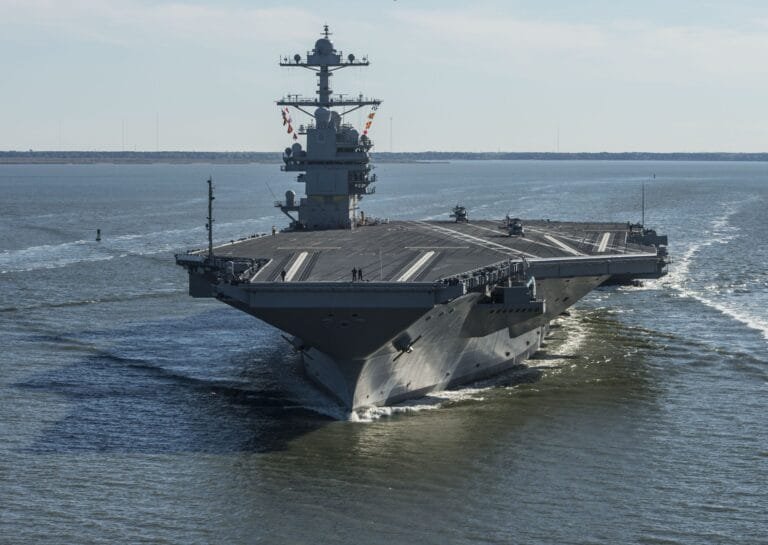
Washington, DC – US reports have revealed a new operational crisis aboard the aircraft carrier USS Gerald R. Ford, involving a widespread sewage overflow within the ship’s holds. This was caused by recurring blockages in the toilet pipes.
According to Military Watch Magazine, the malfunction is part of chronic problems with the ship’s drainage system that have plagued it for years. These problems have led to frequent breakdowns that have impacted the daily lives of the crew.
Hundreds of malfunctions in a few days
The crisis worsened last January while the carrier was deployed to the Caribbean. It was later redeployed to the eastern Mediterranean as part of a broader U.S. military buildup in the region.
Reports, including one in the Navy Times, indicated that hundreds of the ship’s more than 600 toilets malfunctioned intermittently, sometimes forcing sailors to wait up to 45 minutes to use them.
Internal records show 205 malfunctions in just four days in 2025. An average of one daily maintenance request related to the drainage systems was also recorded during deployments.
High cost and pressure on the crew
Frequent malfunctions forced the ship’s command to request external technical support dozens of times since 2023. A specialized acid cleaning system was also used to remove buildup, at a cost of approximately $400,000 each time. This procedure is only performed while the ship is docked.
The stress of long hours repairing malfunctions, coupled with extended deployments, has taken a toll on crew morale. Despite this, U.S. Navy officials maintain that the problems have not affected combat readiness.
A record of technical failures
The funding crisis is part of a series of technical malfunctions the carrier has faced since entering service in June 2017. These malfunctions have included problems with weapons elevators, electromagnetic catapults, and radar and sensor systems.
At a cost exceeding $17.5 billion, the USS Gerald R. Ford is the most expensive aircraft carrier in the history of the U.S. Navy. Its cost is more than double that of the Nimitz-class carriers. Yet, it did not complete its first full operational deployment until October 2022 after years of delays.