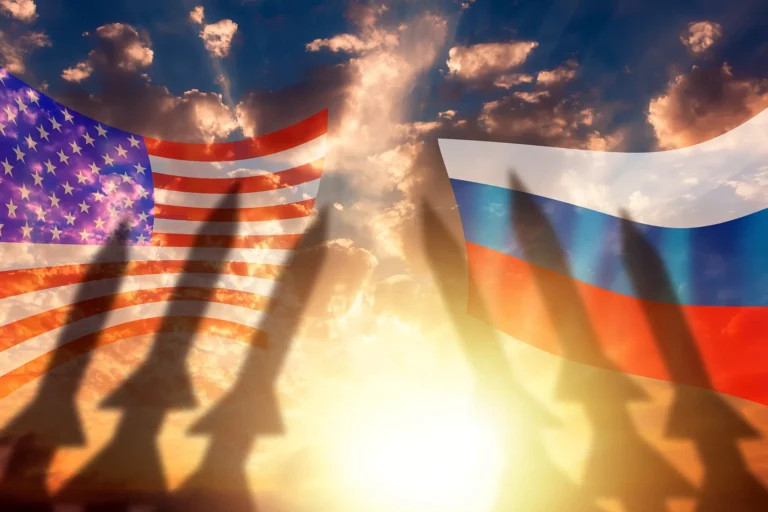
Washington, DC – The United States and Russia are close to reaching an agreement to extend the New START nuclear arms control treaty, Axios reported, citing three sources familiar with the negotiations.
This comes after the treaty officially expired on Thursday.
The New START treaty, signed in 2010, was the last major nuclear arms
control agreement between the world’s two largest nuclear powers.
It imposed strict limits on the number of intercontinental ballistic missiles,
their launchers, and strategic warheads that each side possesses.
It also represents a continuation of Cold War-era arms control agreements.
Axios reported that talks took place in Abu Dhabi over the past 24 hours.
However, a final agreement has not yet been reached,
and it remains unclear whether a formal understanding will be adopted,
committing both sides to voluntarily adhere to the treaty’s terms for an additional six months.
Resumption of military dialogue
The White House did not immediately comment on the report,
which comes amid a series of significant developments in US-Russian relations.
These developments have included the resumption of military communication channels between the two sides.
Earlier today, the US European Command announced that Washington and Moscow had agreed in Abu Dhabi to resume high-level military dialogue.
In the same vein, Ukrainian President Volodymyr Zelenskyy stated that peace talks
with Russia, with US support, would continue in the coming period.
This came after the conclusion of the second round of negotiations in Abu Dhabi.
nuclear arms reduction agreement
For his part, Kremlin spokesman Dmitry Peskov affirmed that Russia remains open to dialogue with the United States,
provided Washington offers “constructive responses” to Moscow’s proposal
to adhere to the limits of the New START treaty despite its expiration.
Peskov added that any positive response from the American side would pave the way for direct negotiations.
The treaty allowed for one previous five-year extension, agreed upon
by former US President Joe Biden and his Russian counterpart Vladimir Putin.
Any further extension or additional voluntary commitment requires an executive decision from both parties.
Meanwhile, US President Donald Trump is attempting to involve China in any future nuclear arms control agreement.
However, Beijing has so far refused to join these negotiations,
maintaining that its nuclear arsenal is significantly smaller than those of the US and Russia.
It is estimated at only about 600 warheads, compared to approximately 4,000 each for Washington and Moscow.