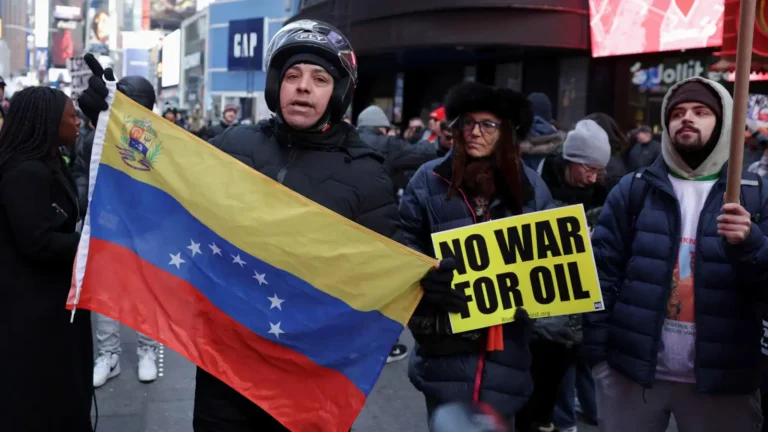
Caracas, Venezuela – Thousands of people took to the streets of Caracas, the Venezuelan capital, to protest what authorities and government supporters described as Washington’s “detention of President Nicolás Maduro.” This scene reflects a new political escalation between Venezuela and the United States and portends a renewed wave of regional tension.
The protesters carried pictures of Maduro and banners attacking the US administration, accusing Washington of attempting to impose political control over Venezuela. They also accused the US administration of using legal and diplomatic pressure as a tool to overthrow the elected leadership. The crowds chanted slogans affirming “national sovereignty” and rejecting what they considered blatant interference in the country’s internal affairs.
Government officials stated that the popular movements were a response to “arbitrary US measures” targeting the Venezuelan head of state. They considered the events to be an extension of a long-standing political and economic war aimed at breaking Caracas’s will. Furthermore, they asserted that the US seeks to reshape the political landscape according to its interests. In statements made during the demonstrations, leaders of the ruling Socialist Party emphasized that Maduro is “not only legally detained,” but also “politically besieged” through sanctions, prosecutions, and threats. They also affirmed that the response would be greater internal unity and increased diplomatic pressure.
In contrast, Washington has not issued a direct comment on these accusations, while continuing to assert that its position on Maduro is based on “legal and human rights issues.” Caracas, however, rejects this stance, describing it as a cover for regime change through soft power.
Observers believe that the scale of these demonstrations reflects an attempt by the Venezuelan government to remobilize public opinion in the face of external pressures. This comes especially amidst a crippling economic crisis and internal political tensions. They also noted that confrontation with Washington remains a key rallying cry in the government’s rhetoric.
These developments come at a time of political upheaval in Latin America. Simultaneously, anti-American sentiment is escalating in several countries. This gives Caracas greater scope to internationalize its crisis and present it as part of a broader struggle for sovereignty and independence.
Between the angry public and the exchange of political messages, Venezuela remains once again at the heart of an open confrontation, its stated aim being “defending the president.” At its core, however, it is a clash of wills that shows no sign of abating.