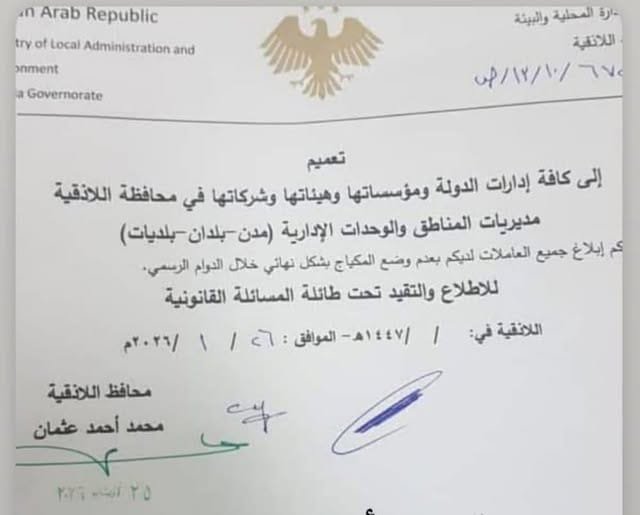
Damascus, Syria – A directive issued by the governor of Latakia, western Syria, Muhammad Othman, has sparked outrage among women’s and community groups in the province. The directive prohibits female employees in all government departments, institutions, and affiliated companies from wearing makeup during official working hours. The directive, described by activists as “surprising,” went beyond simply banning makeup. It also stated that violators would be subject to “legal accountability,” without providing any clear legal or administrative justification for interfering with the personal appearance of female employees. Women’s rights activists have condemned this as “an overreach of authority and an infringement on individual freedom.”
This decision comes in Latakia province, the historical stronghold of the Alawite sect, which has historically enjoyed greater social freedoms compared to other regions. Observers believe the directive reflects the new government’s attempt to impose conservative values on areas that were previously less restrictive. Furthermore, this move may carry a political message that could exacerbate existing social tensions.
The reactions were sharp, with feminist activist Rima Fleihan describing the decision as “a blatant interference in public freedoms.” Residents of the province expressed their fear that this decision could be a prelude to broader social and political restrictions, particularly targeting women. The decision coincided with reports of the confiscation of beauty salons in Damascus, indicating a growing trend among local authorities to restrict the private sphere of Syrian women.
Political analysts saw this directive as exposing the falsehood of the new government’s public relations campaigns, which attempted to portray it as a moderate, civilian administration to the West. On the other hand, the reality on the ground reveals a trend toward moral censorship of public institutions. Angry comments flooded social media platforms, with followers questioning the government’s priorities amidst the difficult economic conditions, asking: “Have the province’s problems with services and living standards been solved that officials now have the time to monitor women’s faces?” This decision reopens the debate on public freedoms in the country. It also raises concerns about the increasing imposition of social restrictions on women by local authorities, particularly in culturally and religiously diverse areas.