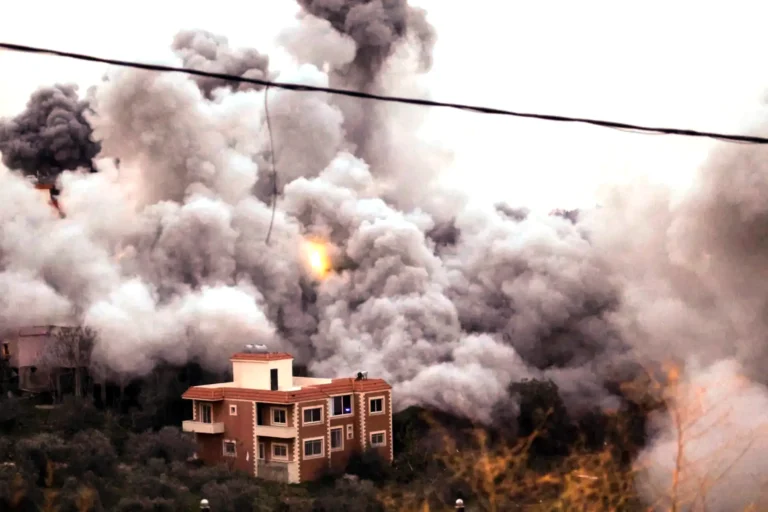
Tel Aviv, Israel – Israel announced on Sunday the killing of a Hezbollah military official and two operatives in two separate attacks targeting different areas in southern Lebanon.
This marked a new escalation despite the ceasefire that has been in place between the two sides since the end of 2014.
The Israeli army said in a statement that it carried out an airstrike earlier on Sunday in the Bazouriyeh area.
That attack killed Muhammad al-Husseini, whom it described as Hezbollah’s artillery commander in the village of Arzoun in southern Lebanon.
According to the Israeli statement, al-Husseini played a pivotal role in managing
and developing Hezbollah’s artillery capabilities in the southern region.
The statement also noted that, in addition to his military activities, he worked as a teacher at a local school in the village.
Hezbollah artillery repair
The Israeli army explained that during the war, al-Husseini played a prominent role in planning
and overseeing several rocket attacks targeting Israeli army positions.
He had also recently been involved in efforts to repair and rehabilitate Hezbollah’s artillery systems. These systems had been damaged in recent strikes.
In a separate airstrike, the Israeli military announced the killing of another Hezbollah operative, Jawad Basma,
after targeting a site in the Bir al-Sanasil area of southern Lebanon.
The statement indicated that Basma was working inside a facility used for weapons production.
However, it did not disclose further details about the nature of the site or the extent of the damage.
Violations of understandings
The Israeli military confirmed that both operations were part of what it described
as “response to violations of the understandings between Israel and Lebanon.”
It also emphasized that it would continue to work to eliminate any security threat targeting Israel.
Since the ceasefire between Israel and Lebanon began at the end of 2014,
the Israeli military has announced the killing of more than 400 Hezbollah members in airstrikes.
These were mostly concentrated in southern Lebanon, with limited operations
also carried out in the Bekaa Valley and the southern suburbs of Beirut.