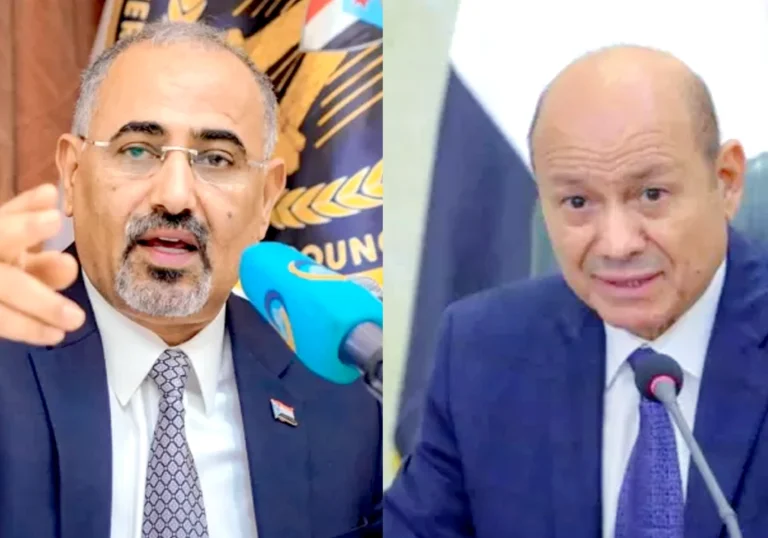
Aden, Yemen — The Yemeni political scene has witnessed an unprecedented dramatic escalation over the past few hours, placing the political partnership within the “Presidential Leadership Council” on the brink of collapse.
This followed presidential decisions to revoke the membership of the President of the Southern Transitional Council, Aidarus Al-Zubaidi, and accuse him of treason.
These developments coincided with coalition airstrikes in Al-Dhalea.
Isolation and referral
The head of the Presidential Leadership Council, Rashad al-Alimi, officially announced the dismissal of Aidarus al-Zubaidi from the council. He was also referred to the Attorney General on charges of “high treason.”
The presidential decrees also included the dismissal of two ministers belonging to the Transitional Council,
a move that comes after weeks of military tension in the eastern provinces.
Transitional: The president is in Aden
Earlier, the Southern Transitional Council categorically denied the escape story. In a statement, it affirmed that al-Zubaidi “remains in the capital, Aden,”
and is carrying out his duties overseeing military and civilian institutions.
The Southern Transitional Council indicated that a delegation headed by its Secretary-General, Abdul Rahman al-Subaihi, had already traveled to Riyadh.
And the purpose of the visit was to participate in a conference on the Southern issue. The Council affirmed its commitment to dialogue “
that takes into account the aspirations of the people of the South and their legitimate rights” to secession. It demands a return to the pre-1990 status quo.
Background of the conflict: The Battle of the East
This political explosion stems from the conflict that erupted last December when the Southern Transitional Council (STC) seized control of the Hadramawt and Al-Mahra governorates (roughly half of Yemen’s territory).
Despite international pressure, the STC refused to withdraw.
And this led to the intervention of the government’s “Homeland Shield” forces, backed by the Saudi-led coalition,
to retake the areas earlier this week. The current direct confrontation is the result.
Observers believe these developments effectively mark the end of the Riyadh Agreement.
They also bring to a close the partnership formula established in April 2022. This opens the door to a range of conflict scenarios in southern Yemen.