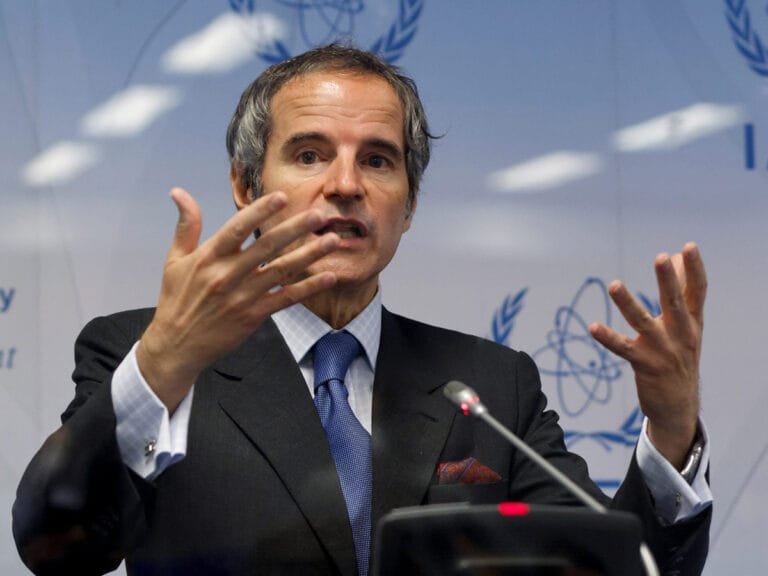
Tehran, Iran – The dispute between the International Atomic Energy Agency (IAEA) and Tehran has entered a new phase of mutual distrust. This comes after IAEA Director General Rafael Grossi demanded that inspectors be allowed to verify on-site Iran’s claims regarding the “lack of security” at its nuclear facilities and the difficulty of accessing its stockpile of enriched uranium.
Grossi: The Iranian narrative needs scrutiny.
In an interview with the Russian news agency RIA Novosti published on Saturday, Grossi responded to the Iranian position, saying: “The Iranian authorities say that the facilities are unsafe and cannot be accessed. But in this case, inspectors should be allowed to verify that access is actually impossible.”
This comes after statements by Iranian officials, including Foreign Minister Abbas Araqchi and government spokeswoman Fatemeh Mohajerani, who asserted that the enriched uranium stockpile is now “buried under the rubble” as a result of the bombing of facilities during the twelve-day war. The IAEA considers this a serious challenge to the international safeguards system.
Tehran: Inspecting “rubble” is an unreasonable demand
For his part, Behrouz Kamalvandi, spokesman for the Atomic Energy Organization of Iran, described the IAEA’s demands for access to those sites as “unreasonable.” In remarks to the ISNA news agency, Kamalvandi indicated that Tehran is exploring “alternative ideas and methods” for inspecting nuclear materials. It also seeks to inform the IAEA of these methods without requiring inspectors to physically access the affected sites.
Iran’s nuclear capabilities still exist
Despite the United States’ earlier declaration of the “complete destruction” of Iran’s nuclear facilities, Grossi asserted that Iran’s nuclear program is “highly sophisticated.” He emphasized that it extends far beyond the sites that were bombed. He also pointed to the existence of robust research and scientific components and numerous facilities spread throughout the country, including the Bushehr plant and joint projects with Russia. Grossi stressed that Iran remains obligated under the Nuclear Non-Proliferation Treaty (NPT) to grant access to inspectors.
Moscow calls for neutrality
On the diplomatic front, Russian Foreign Minister Sergey Lavrov urged Grossi to adopt a “professional and impartial approach.” He also called on the IAEA Secretariat to maintain complete neutrality in its assessments of Iran’s nuclear program and to avoid politicizing the issue, particularly in light of Grossi’s efforts to revive relations with Tehran.
The issue of “uranium under the rubble” now constitutes the most significant sticking point in the ongoing negotiations. The international community fears that Tehran might exploit the state of the facilities to conceal quantities of highly enriched uranium, seeking to hide it from international inspectors.